In enterprise roasting economics, inventory degradation represents an unhedged operational risk. When raw beans suffer premature past-cropping, flavor flattening, or cellular lipid oxidation in destination warehouses, roasting formulas collapse and commercial margins evaporate. Achieving superior green coffee shelf life storage India requires rigorous biochemical stabilization at origin. Draba Ventures engineers high-density Arabica and Robusta lots that endure 12 to 18 months of destination storage across global maritime hubs like Hamburg, Antwerp, Trieste, and New York, delivering pristine cupping fidelity and flawless inventory liquidity for industrial roasters.
Maximizing Green Coffee Shelf Life in Destination Warehouses
Raw green coffee is a living, hygroscopic biological structure. Inside every unroasted bean, complex cellular membranes enclose delicate lipids, organic acids, sucrose, and aromatic precursors. When exposed to fluctuating ambient humidity and thermal variations, cellular degradation accelerates through three distinct biochemical pathways:
- Enzymatic Hydrolysis and Lipid Oxidation: Free fatty acids on the bean surface break down into peroxides and aldehydes, generating woody, cardboard, and baggy off-flavors that ruin cup brightness.
- Chlorophyll Breakdown (Fading): Moisture migration triggers chlorophyll degradation, causing raw jade-green beans to turn pale yellow or brown, visually signaling past-crop age to sensory auditors.
- Sucrose and Soluble Solid Depletion: Prolonged respiration slowly exhausts the sucrose reservoir, robbing roasted coffee of natural sweetness, acidity, and caramelization potential.
At Draba Ventures, origin-level engineering prevents destination decay. By strictly controlling the terminal drying curve in Karnataka's Western Ghats and stabilizing water activity (aw) between 0.55 and 0.58, our beans enter a deep metabolic dormancy. Commercial roasting conglomerates can confidently store bulk container lots in unheated European or North American destination warehouses for 12 to 18 months without losing cupping points or altering roasting curve kinetics.
| Quality Metric | Conventional Jute Sacks | Draba Hermetic Preservation Standard | Roasting Advantage |
|---|---|---|---|
| Stable Shelf Life | 4 to 6 months before past-crop fading | 12 to 18 months stable dormancy | Year-round forward contract security |
| Water Activity (aw) | Unregulated (0.68 - 0.75 aw) | Strictly 0.55 - 0.58 aw | Complete mold & OTA suppression |
| Moisture Content | Fluctuates with ambient humidity (13-14%) | Maintained between 10.5% and 11.5% | Consistent thermal heat transfer |
| Sensory Cupping Stability | Drops 2.0 to 3.5 points in 9 months | Cupping score variance < 0.5 points | Zero formula reformulations |
| Inventory Shrinkage | 2.0% - 4.5% weight loss & insect spoilage | 0.0% weight change, zero insect ingress | 100% audited capital preservation |
Just-In-Time (JIT) Roasting and Inventory Liquidity
Industrial roasting plants and multinational retail brands operate under strict working capital constraints. Holding fresh green coffee inventory that rapidly spoils forces procurement managers to purchase small, fragmented spot-market volumes at volatile price premiums. Conversely, holding biochemically stable green coffee creates strategic inventory liquidity.
Maximizing raw coffee shelf life empowers enterprise roasters to execute Just-In-Time (JIT) manufacturing protocols:
- Mitigating Spot-Market Volatility: Procurement directors can contract full container volumes (18 to 21 metric tons) during optimal harvest windows, locking in favorable farmgate FOB rates without fear of mid-year quality degradation.
- Buffer Against Shipping Bottlenecks: With ocean freight transit times subject to Red Sea diversions and canal bottlenecks, having 18-month stable green inventory positioned at bonded European or US distribution centers guarantees unbroken continuous roasting lines.
- Roasting Profile Consistency: Drum and hot-air roasters (such as Probat, Neuhaus Neotec, or Loring) rely on uniform cellular moisture for precise thermal conduction. Moisture-stable beans react identically whether roasted in month 2 or month 16, preserving proprietary roasting recipes without operator intervention.
- Working Capital Optimization: High inventory stability allows companies to collateralize stored green coffee with commercial trade financiers, optimizing treasury liquidity and reducing cost of goods sold (COGS).
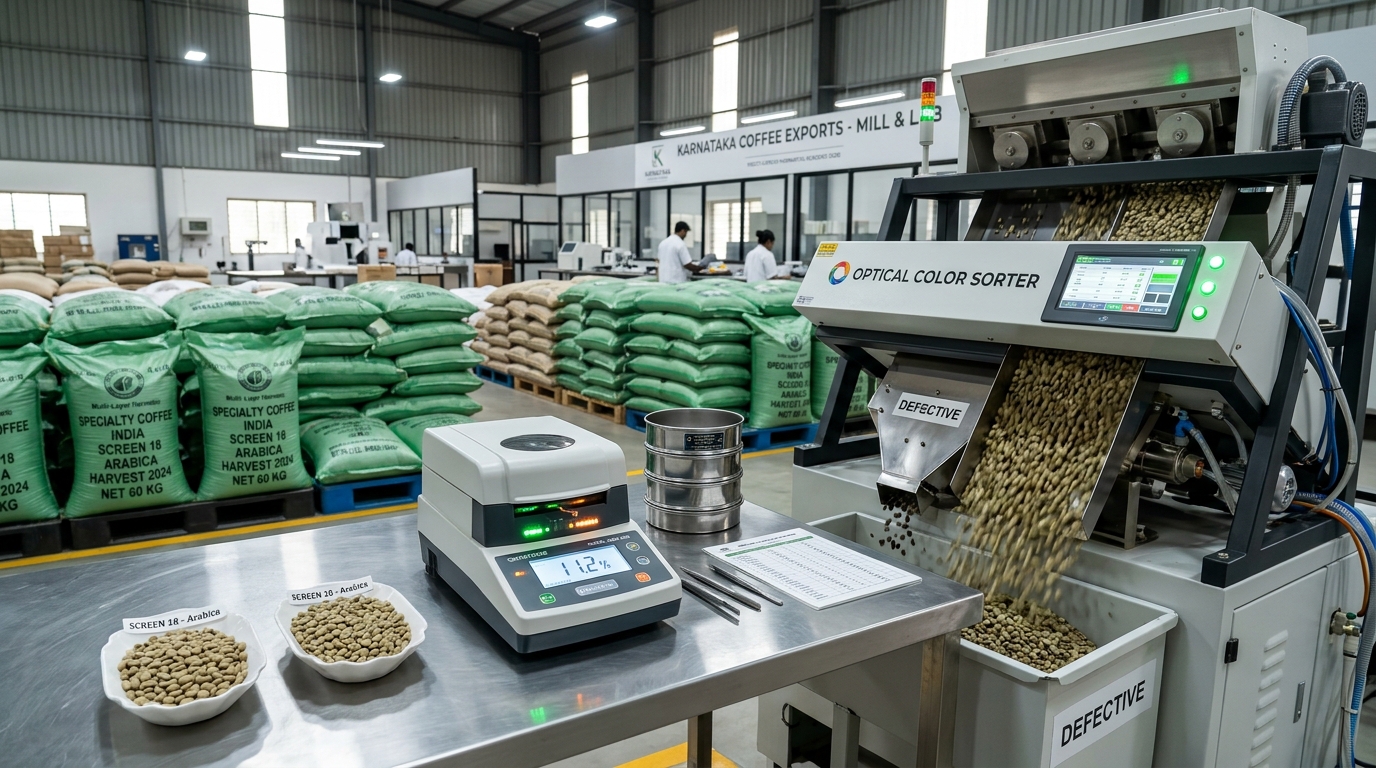
Figure 1: Quality control compliance inside our Karnataka curing mill. High-speed VIS/NIR Sortex sorting eliminates chipped beans before lots are hermetically sealed in multi-layer GrainPro liners.
Quality Assurance and Optical Defect Extraction
A single defective green coffee bean can spoil an entire bag during extended storage. Chipped beans, broken fragments, and insect-damaged seeds expose vulnerable inner lipid layers to atmospheric oxygen, becoming breeding grounds for mold spores and hydrolytic rancidity.
Draba Ventures integrates advanced sorting technologies to guarantee pristine physical lot integrity:
- VIS/NIR Hyperspectral Sorting (94.63% Accuracy): Every lot undergoes high-speed optical scanning via VIS/NIR Hyperspectral Imaging (HSI) Sortex machinery operating at 94.63% optical defect ejection accuracy. The system inspects individual beans across visible and near-infrared spectrums, identifying micro-fractures, internal insect borers, and chemical decay undetectable by standard trichromatic cameras.
- Elimination of Degradation Catalysts: Removing hollow, broken, and insect-damaged seeds eliminates the cellular debris that accelerates moisture reabsorption and lipid oxidation across the bulk lot.
- Strict Physical Screen Grading: Green coffee is graded to exact export screen standards: Screen 18+ for Plantation AA and Cherry AA, and Screen 15/16 for AB grades. Uniform physical bean geometry ensures identical air circulation and moisture equilibrium inside hermetic bags.
- Mechanical Cleanliness Over Chemical Gassing: Superior optical cleaning and gravitational destoning eliminate organic foreign matter at origin, removing the need for aggressive post-harvest chemical treatments.
Moisture Control and Hermetic Storage Solutions
Moisture management is the single most critical factor determining raw coffee shelf life. Green coffee with moisture above 12.5% or water activity exceeding 0.65 aw creates an ideal environment for xerophilic fungi such as Aspergillus ochraceus, which synthesizes Ochratoxin A (OTA), a hazardous nephrotoxic mycotoxin strictly regulated by international food safety authorities.
Draba Ventures safeguards bulk shipments through an impenetrable moisture barrier protocol:
- Sun-Cured and Kiln-Stabilized Moisture (<12.0%): Raw coffee parchment and cherry are slowly dried on clean raised tables and finished in mechanical dryers to reach an optimal 10.5% to 11.5% moisture content. Each batch is validated using calibrated digital dielectric capacitance moisture analyzers.
- Hermetic GrainPro Liners: Lots are packaged in heavy-duty 60kg export jute sacks fitted with multi-layer gastight and moisture-tight GrainPro hermetic liners. These multi-barrier polymer films block atmospheric oxygen transmission and moisture vapor transfer, locking in the origin microclimate.
- OTA Prevention Standard: Maintaining bean water activity strictly between 0.55 and 0.58 aw completely inhibits fungal spore germination, ensuring finished lots arrive in destination ports with OTA levels far below the strict European Union limit of 3.0 micrograms per kilogram (ppb).
- Containerization at New Mangalore Port (NMPA): Standard 20ft FCLs (loading 300 bags x 60kg, 18.0 metric tons) are lined with kraft paper, thermal blankets, and high-capacity calcium chloride container desiccant poles, preventing container sweat and condensation during trans-equatorial maritime voyages.
