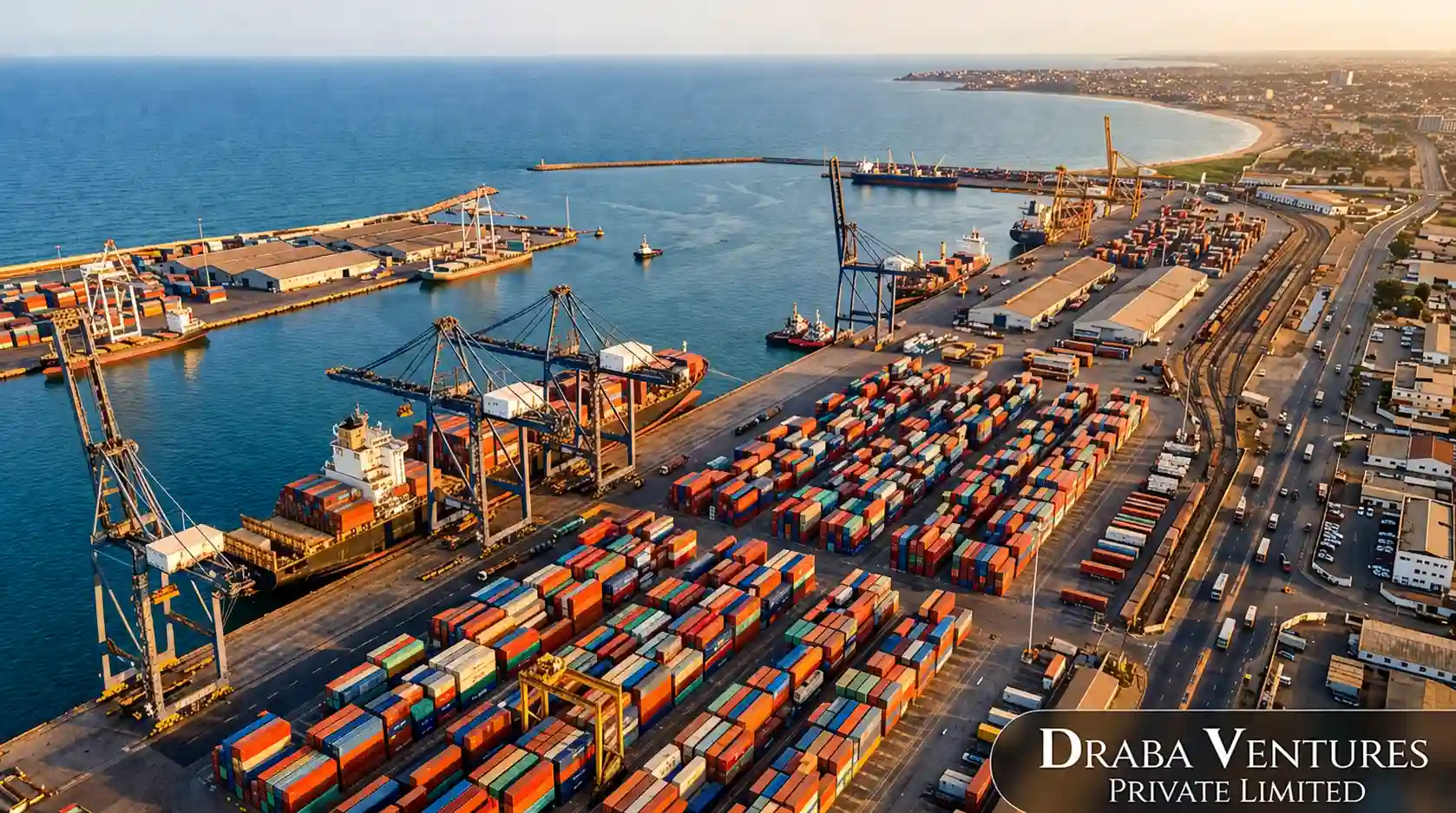
The Port Autonome de Cotonou (PAC) is far more than an ocean terminal – it is the economic heartbeat of Benin and one of the most strategic maritime gateways in West Africa. Every year, hundreds of thousands of tonnes of Indian non-basmati and parboiled rice transit through this facility to supply consumers across Benin, Nigeria, Niger, and Ghana.
For commercial rice buyers importing shipments from Indian milling hubs, mastering the operational workflows of Cotonou Port is the difference between healthy gross margins and crippling demurrage penalties. This technical guide outlines the essential procedures, tariffs, and timelines required for flawless port clearance.
Cotonou Port at a Glance
The PAC is Benin's only deep-water port and one of the most active in West Africa. Its geographic position makes it a natural transit hub for landlocked countries in the sub-region:
Ready to Import IR64 Rice and Parboiled Varieties?
Get an instant FOB and CIF cost estimate including sea freight and marine insurance directly to Cotonou.
- Capacity: Over 10 million tonnes of goods handled per year
- Containers: Over 400,000 TEUs (twenty-foot equivalent units) per year
- Transit countries served: Niger, Burkina Faso, Mali, Chad
- Key commodity: Rice is one of the highest-volume import categories
- Manager: Port Autonome de Cotonou (PAC), public port authority
Cotonou port is not just an import port for Benin – it is the commercial gateway for the entire francophone West Africa region. Rice entering Cotonou frequently ends up in Lagos, Niamey, Ouagadougou, or N'Djamena within days.
Rice HS Codes at Cotonou
The HS (Harmonised System) code is critical for customs clearance. Using the wrong code can trigger incorrect duty charges or processing holds. Here are the codes for Indian rice:
| Rice Type | HS Code | Description | ECOWAS CET Duty |
|---|---|---|---|
| Paddy rice (unmilled) | 1006.10 | Rice in the husk (paddy or rough) | Verify with forwarder |
| Husked (brown) rice | 1006.20 | Husked (brown or cargo) rice, incl. parboiled | Verify with forwarder |
| Semi-milled or milled rice | 1006.30 | White rice, parboiled or otherwise | Verify with forwarder |
| Broken rice | 1006.40 | Broken rice (100% broken, 5% broken) | Verify with forwarder |
Note: Exact ECOWAS Common External Tariff (CET) rates change periodically. Always verify the applicable rate with your licensed freight forwarder in Cotonou before each shipment.
Customs Clearance Procedure – Step by Step
Vessel Arrival D0
The vessel berths at Cotonou port. The shipping line submits the cargo manifest to the port authority. The container is discharged and placed in the terminal storage area.
Document Submission D1-D2
Your freight forwarder submits original documents to Beninese customs: commercial invoice, packing list, original B/L, phytosanitary certificate, certificate of origin, and fumigation certificate into Benin's ASYCUDA system.
Customs Declaration (DUM) D2-D3
Your forwarder files the import declaration (DUM – Déclaration Unique en Matière de Douane). Duties and taxes are calculated on the CIF value at Cotonou and paid at the customs treasury office.
Customs Inspection D3-D4
Beninese customs may conduct a physical inspection of the container. Perfectly consistent documentation accelerates processing significantly through the green channel.
Release Order (Bon à Enlever) D4-D5
After verification and duty payment, customs issues the 'Bon à Enlever' (BAE) – the release order authorising the container to exit the port.
Container Exit D5-D7
On presentation of the BAE and the shipping line's delivery order, the container exits the terminal to your warehouse. The empty container must be returned within the agreed timeframe.
Estimated Port Charges at Cotonou (per 20ft container)
Cost Estimate – 1×20ft FCL Rice to Cotonou
Demurrage – The Cost Trap to Avoid at All Costs
Demurrage charges are billed by shipping lines when you fail to collect your container within the free time period. At Cotonou port, this free time is typically 7 to 14 days depending on the shipping line and service agreement.
After the free time expires, demurrage accumulates rapidly:
- Days 1-5 after free time: approximately $50-$80 per day
- Days 6-10: approximately $100-$150 per day (progressive rate)
- Beyond 10 days: up to $200+ per day depending on the shipping line
Critical Operational Guideline: Have original documents (especially the B/L) dispatched by courier (DHL) on the very day the container is loaded in India. Delayed document receipt is the number one cause of demurrage for Beninese importers.
Shipping Lines Serving the India-Cotonou Route
MSC generally offers the most direct and fastest service for the Chennai-Cotonou route. Your Indian exporter will advise on available carriers at the time of shipment.
Practical Tips for Smooth Rice Imports at Cotonou
- Choose an experienced freight forwarder: An established Cotonou customs broker significantly accelerates clearance. Verify credentials beforehand.
- Send B/L number to your forwarder immediately: As soon as the exporter shares it, forward the B/L draft and copy so the forwarder can pre-lodge the declaration.
- Track your container daily: All major carriers offer free container tracking. Monitor progress continuously as arrival approaches.
- Prepare duty payment funds in advance: Import duties must be cleared before the release order (BAE) is issued. Secure liquid funds early.
- Maintain high-resolution digital scans: If originals are delayed, clear scans enable quick pre-validation and prompt dispute resolution.
FAQ – Cotonou Port for Rice Importers
Shipments to Cotonou – Draba Ventures Delivers
We ship regularly to Cotonou port. Clean documentation dispatched before vessel arrival, real-time tracking, and competitive CIF Cotonou rates.
