Executing direct-trade Indian green coffee imports on FOB New Mangalore Port (NMPT) or CIF destination terms allows commercial buyers to reclaim 15% to 22% in gross operating margin by eliminating multi-tier broker commissions. Export consignments are standardized under strict Coffee Board of India oversight, incorporating VIS/NIR Hyperspectral Imaging Sortex cleaning (94.63% optical defect extraction) and multi-layer GrainPro hermetic liners with moisture stabilized under 12.0% (11.2%-11.5%) to eliminate Ochratoxin A (OTA) maritime risks.
Executing direct-trade Indian green coffee imports provides commercial roasters, commodity brokers, and private-label distributors with a mathematically verifiable procurement hedge against global terminal market volatility. By bypassing intermediary brokers in secondary trade hubs, industrial buyers establish direct contractual alignment with primary processing mills in the Western Ghats, securing traceable, single-origin lots with guaranteed physical and biochemical parameters.
India stands as the world's seventh-largest coffee producer, exporting over 380,000 Metric Tons annually. Its uniquely shade-grown estates in Karnataka, Kerala, and Tamil Nadu produce high-density Indian Arabica and Robusta green coffee beans. This technical guide outlines the operational steps required to contract, inspect, clear, and transport containerized Indian green coffee lots directly from origin to your destination port.
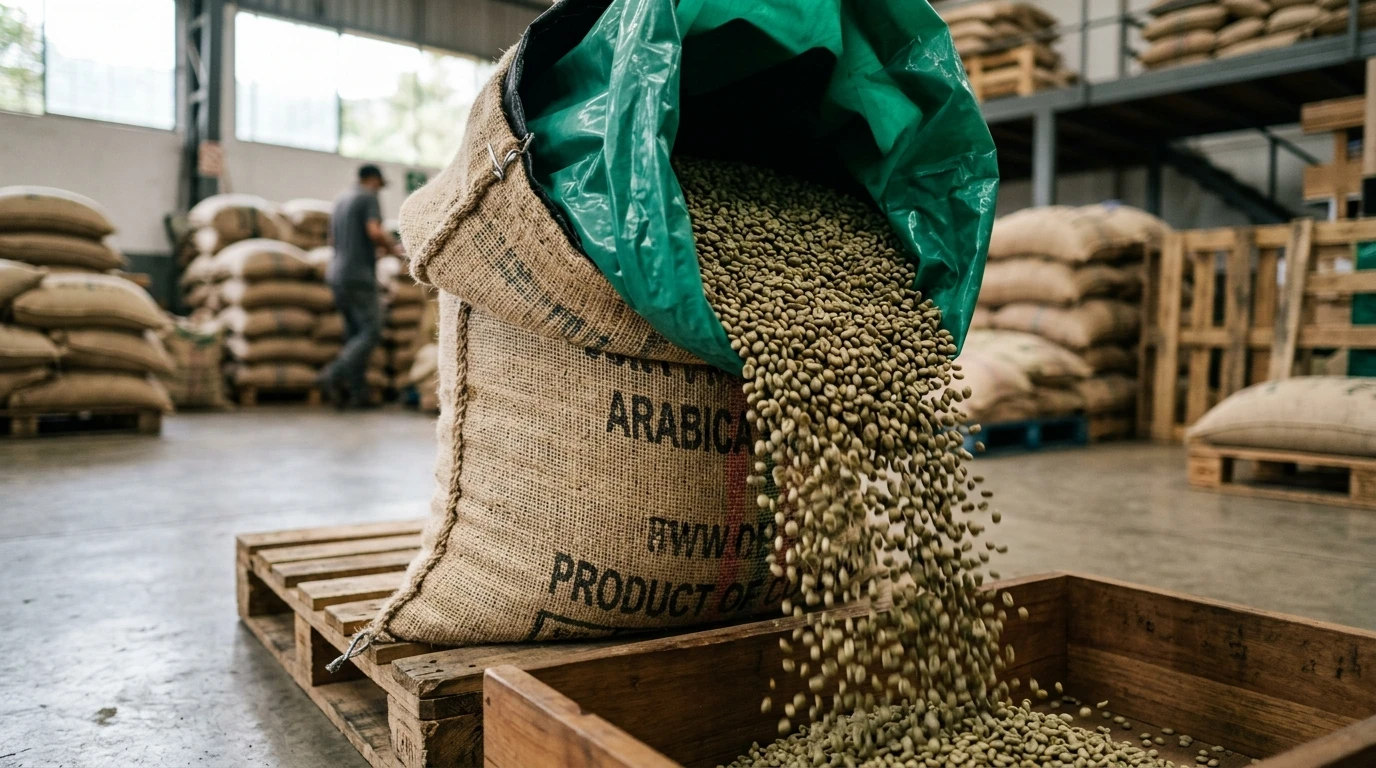
The Economics of Bypassing Domestic Brokers
Direct sourcing from an established primary exporter allows international procurement teams to reclaim between 15% and 22% in gross operating margin previously lost to broker markups and multi-tier trading desks. Establishing direct contracts on Free On Board (FOB) New Mangalore Port (NMPT) or Cost, Insurance, and Freight (CIF) terms standardizes invoice transparency, eliminating undisclosed handling spreads and storage surcharges.
In conventional green coffee distribution, an import consignment passes through up to four intermediaries before arriving at the roastery: regional estate aggregators, local commission agents, destination port dealers, and wholesale jobbers. Each entity extracts a margin spread ranging from 3.5% to 7.0%, while adding zero value to bean physical grade or cup profile.
| Procurement Tier | Supply Chain Intermediary | Cumulative Margin Mark-Up | Primary Financial & Physical Risk |
|---|---|---|---|
| Tier 1: Broker Chain | Estate Aggregators & Local Agents | +4.5% to +7.0% | Lot blending, screen size inconsistency |
| Tier 2: Trade House | Export Commission Brokers | +3.5% to +5.5% | Extended warehouse staging, moisture pickup |
| Tier 3: Spot Dealer | Destination Hub Warehousing | +7.0% to +9.5% | Financing carry costs, aged crop past crop mixing |
| Draba Direct-Trade | Primary Origin Curing Mill (Direct) | 0.0% Middleman Spread | Zero Intermediary Risk; Single-Estate Traceability |
Direct export contracts executed directly through Draba Ventures' Green Coffee Division peg pricing transparently against the ICE Arabica (New York "C") or ICE Robusta (London) terminal benchmark, adjusted for verified grade differentials (e.g., Robusta Cherry AB Screen 17, Arabica Plantation A Screen 17, or Monsooned Malabar AA Screen 18).
Quality Assurance and Optical Defect Extraction
Export-grade green coffee requires systematic defect elimination based on Coffee Board of India and International Coffee Organization (ICO) physical grading standards. Draba Ventures utilizes VIS/NIR Hyperspectral Imaging (HSI) Sortex machines achieving 94.63% optical sorting accuracy to eliminate primary physical defects, insect damage, and discolored kernels prior to export staging.
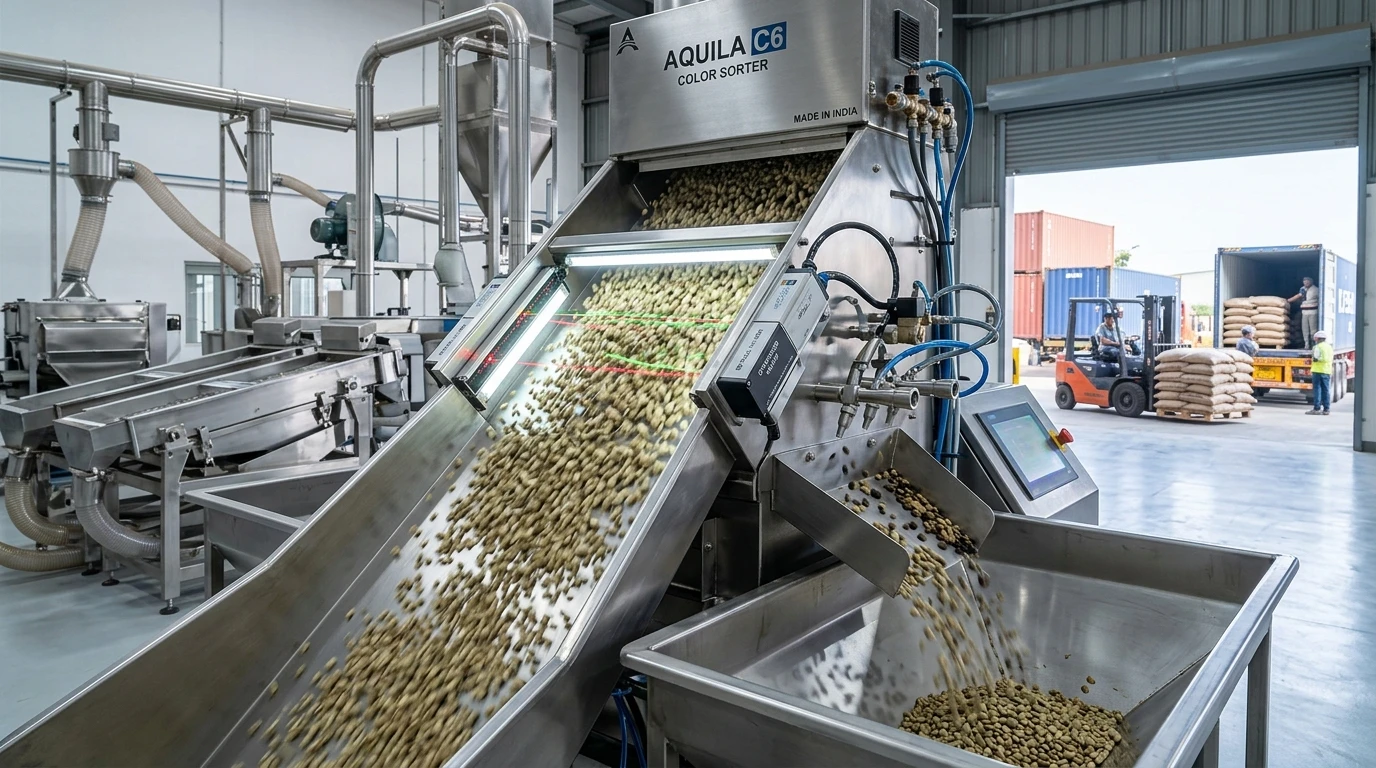
Manual hand-sorting alone cannot eliminate sub-surface fungal pockets, immature beans (quakers), or internal stinkers that ruin industrial batch consistency. Our processing line integrates gravity separation tables, multi-deck rotary screen size separators, and dual-sensor optical sorters operating across visible and near-infrared spectral wavelengths.
Physical Grade Metrics by Indian Standard Specifications
- Arabica Plantation A: Screen 17 (6.75 mm) retention minimum 90.0%; maximum defect allowance 1.0% by weight; zero black or sour beans tolerated.
- Arabica Plantation PB (Peaberry): Oval round-form screen separation; high thermal conductivity in drum roasting; maximum 1.5% defect allowance.
- Robusta Cherry AB: Screen 17 (6.75 mm) retention minimum 85.0%; bulk density stabilized at 509 g/L; suited for thick crema extraction and espresso base structuring.
- Monsooned Malabar AA: Monsooned process; screen size 18 (7.10 mm); neutral golden yellow color profile; total acidity reduced below 4.8 pH.
| Target Parameter | Commercial Commodity Standard | Draba Ventures Export Grade | Quality Verification Instrument |
|---|---|---|---|
| Optical Sorting Yield | 82.0% - 87.0% | 94.63% Precision Yield | VIS/NIR Hyperspectral Sortex |
| Total Physical Defects | Max 3.0% by weight | < 0.75% Secondary Defects Only | ISO 4149 / Coffee Board Standard |
| Screen 17/18 Retention | 80.0% Minimum | 92.5% Certified Retention | Rotary Mechanical Sieves |
| Foreign Matter Count | Max 0.25% | 0.00% (Zero Stones/Metals) | Dual-Pass Rare-Earth Magnetic Destoners |
Moisture Control and Maritime Security
Ocean container sweat and relative humidity shifts during equatorial voyages cause rapid moisture sorption, promoting Aspergillus ochraceus fungal germination and toxic Ochratoxin A (OTA) contamination. Draba Ventures stabilizes moisture strictly below 12.0% (target 11.2%-11.5%) and encases every lot in 80-micron multi-layer GrainPro hermetic liners within 60kg jute bags, guaranteeing European Union regulatory compliance (maximum 3.0 μg/kg OTA).
Green coffee beans are hygroscopic biological commodities. When ocean vessels pass from tropical origin ports (such as New Mangalore or Cochin) into colder European or North American waters, ambient temperature differentials within standard 20ft dry boxes cause internal air condensation - known as "container sweat." Unprotected burlap bags absorb this liquid condensate, resulting in rapid moisture spikes above 14.5% within 48 hours.
To eliminate bio-contaminant development during maritime transit, our packaging protocol enforces strict three-tier defense engineering:
- Mechanical Pre-Staging Moisture Audit: Moisture levels are calibrated on calibrated Shore / Sinar capacitance analyzers. Consignments exceeding 12.0% moisture are rejected from containerization.
- GrainPro Ultra-Hermetic Liners: Lots are sealed inside high-barrier multi-layer polyethylene liners with oxygen transmission rates below 4.0 cc/m²/day and water vapor transmission below 5.0 g/m²/day. This starves aerobic fungal spores of metabolic oxygen.
- Container Desiccant Pole Arrays: Every 20ft container is outfitted with four 2kg calcium chloride desiccant poles rated to absorb 300% of their dry weight in ambient condensation.
Navigating Export Certifications and Customs Clearance
Lawful export of Indian green coffee requires mandatory permits issued by the Coffee Board of India (Ministry of Commerce and Industry), APEDA export registration, an International Coffee Organization (ICO) Certificate of Origin, and a Plant Quarantine Inspection Certificate (Phytosanitary). Draba Ventures provides complete digital and courier-dispatched documentation suites prior to vessel departure.
Navigating customs protocols requires strict adherence to international documentation standards. Missing or improperly classified export manifests result in terminal demurrage penalties, quarantine holds, or rejected consignments at destination ports.
| Statutory Document | Issuing Authority | Operational Purpose | Destination Verification Body |
|---|---|---|---|
| Coffee Board Export Permit | Coffee Board of India | Validates quality grade, ICO mark, and export quota | Indian Customs (ICEGATE) |
| ICO Certificate of Origin | Coffee Board of India / ICO | Authenticates geographical origin and tariff eligibility | Global Customs (EU, US, Middle East) |
| Phytosanitary Certificate | Ministry of Agriculture (NPPO) | Certifies absence of quarantine pests and bio-hazards | Port Quarantine Services |
| Commercial Invoice & Packing List | Draba Ventures Private Limited | Itemizes net weights, tare weight, lot marks, and contract Incoterm | Customs Clearing Broker |
| Clean on Board Ocean B/L | Designated Ocean Shipping Line | Document of title; governs cargo delivery and port clearance | Consignee & Trade Bank |
Procurement Specifications and Container Economics
To optimize ocean freight costs per kilogram, Draba Ventures standardizes consignments around full container load (FCL) dry boxes. The following table provides the operational parameters for planning contract dispatch schedules:
| Parameter | Standard 20ft FCL (Loose Stuffed) | Palletized 20ft FCL |
|---|---|---|
| Total Net Payload | 18.00 Metric Tons (18,000 kg) | 15.60 Metric Tons (15,600 kg) |
| Packaging Configuration | 300 Jute Bags × 60 kg with GrainPro Liners | 10 Euro-Pallets / Industrial Pallets × 26 Bags |
| Loading Port | New Mangalore Port (IN NML 1) | New Mangalore Port / Chennai Port |
| Lead Time: PSS to On-Board | 14 - 21 Business Days | 16 - 24 Business Days |
| Minimum Order Quantity (MOQ) | 1 × 20ft FCL (18 MT) | 1 × 20ft FCL (15.6 MT) |
Frequently Asked Questions
Initiate Direct-Trade Coffee Procurement with Draba Ventures
Secure direct origin allocation from India's premier coffee belts. Contact our export desk to request an airtight 350g Pre-Shipment Sample (PSS), review recent harvest lab analyses, or lock in forward delivery pricing on FOB Mangalore or CIF destination terms.