The Economics of FOB Mangalore Port (NMPA): Reclaiming Export Margins
In international green coffee procurement, intermediary domestic brokers and regional commission aggregators routinely add 8% to 15% in compounded overheads while providing zero guarantees on physical bean cleanliness, moisture control, or ocean transit security. By establishing direct contracts on Free on Board (FOB) Mangalore terms with an integrated curing and export processor like Draba Ventures, commercial roasters and bulk green coffee importers recapture critical operating margins, lock in terminal-hedged origin pricing, and maintain uncompromised farm-gate traceability.
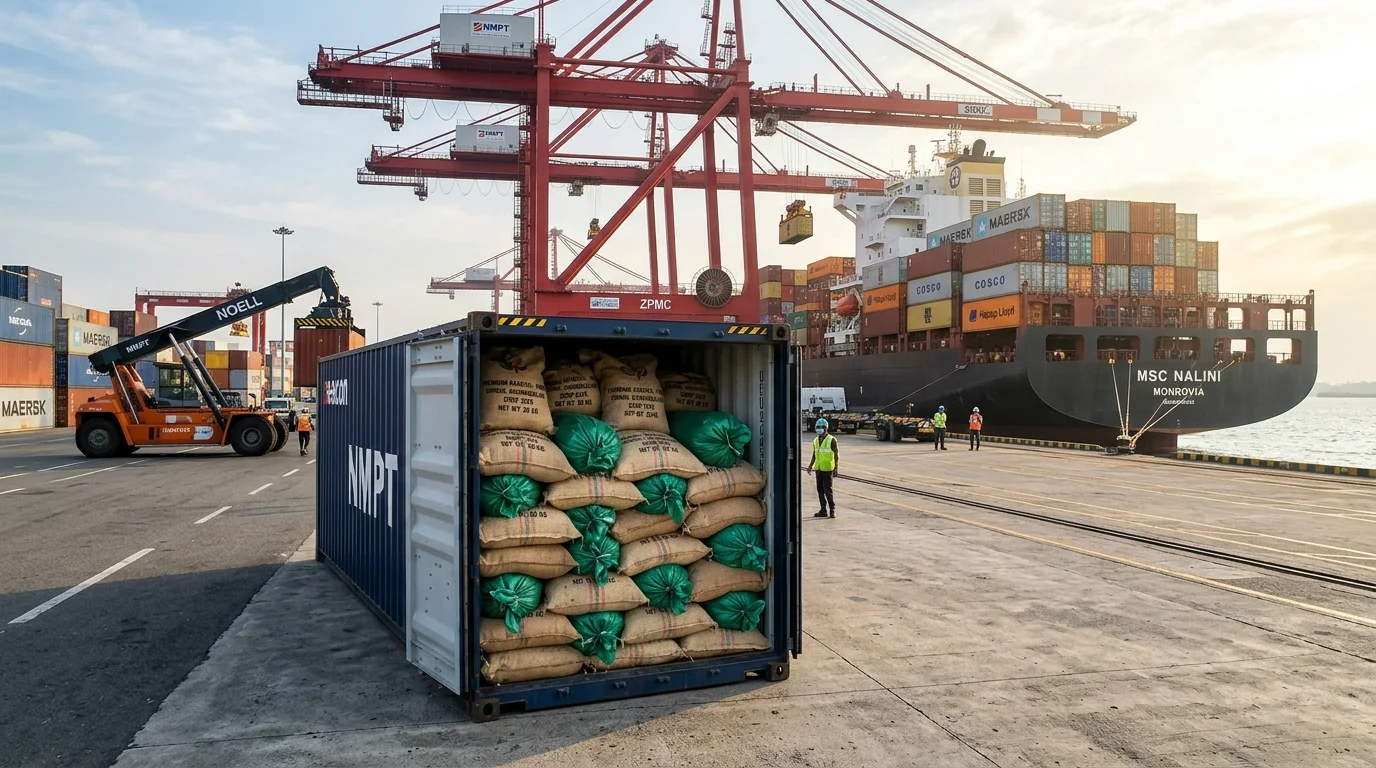
The New Mangalore Port Authority (NMPA), situated along Karnataka's southwestern coastline on the Arabian Sea, serves as the maritime epicentre of Indian coffee exports. NMPA handles upwards of 70% of India's total outbound green coffee volume, making it the highest-volume coffee exporting port in the nation. Its strategic geographic position provides the shortest overland transit distance from the world-renowned shade-grown coffee regions of Chikmagalur, Coorg, and Hassan in the Western Ghats.
Historically, foreign importers who buy through secondary trade channels in regional trading hubs like Bangalore or domestic spot brokers incur substantial compounding expenses. These domestic aggregators purchase uneven estate lots, blend disparate screen sizes, and layer on multiple financing margins and handling fees. By bypassing these domestic consolidators and executing direct commercial export agreements with a primary coffee exporter India FOB Mangalore price specialist, international buyers immediately eliminate third-party commission spreads.
Crucially, contracting on direct FOB NMPA terms protects buyers against localized domestic spot-market price manipulation. In secondary domestic markets, spot prices fluctuate erratically due to local speculative hoarding and inter-trader bidding. Under a structured FOB contract with Draba Ventures, base prices are transparently benchmarked against international terminal exchanges (ICE Arabica New York or ICE Robusta London), adjusted purely for grade-specific origin differentials. This structure insulates your procurement budget from internal domestic volatility while providing complete audit visibility from estate gate to ship rail.
Broker Fee Elimination
0% intermediary commission; eliminates 8% to 15% compounding aggregator and middleman fees.
Terminal Pegged Pricing
Base contract rates benchmarked directly against ICE Arabica NY or ICE Robusta London terminal differentials.
NMPA Deepwater Access
Deepwater berths (-14.0m to -15.1m draft) providing direct container feeder connections to global transshipment hubs.
Estate Lot Traceability
100% direct-from-mill single estate or regional cooperative batch tracking from farm gate to ship rail.
| Procurement Parameter | Traditional Spot Broker / Consolidator | Direct FOB Mangalore (Draba Ventures) |
|---|---|---|
| Intermediary Price Markup | 8% to 15% compounded brokerage & aggregator fees | 0% broker fees; net primary processor export rate |
| Price Volatility Protection | Subject to daily domestic speculative swings | Transparent terminal-pegged FOB pricing (ICE NY/London) |
| Inland Supply Chain Visibility | Opaque blending of disparate smallholder lots | Direct estate-level lot batch traceability |
| Port Berth Loading Access | Frequent third-party staging delays | Priority gate-in at NMPA deepwater container berths |
| Quality Verification Point | Sampled post-transit at congested port yards | 100% VIS/NIR Sortex certified at curing mill pre-dispatch |
Inland Freight and Customs Clearance: From Western Ghats Estates to Port Terminal
Executing an export order requires rigorous overland logistics management. The journey from the high-altitude curing mills of Chikmagalur (approx 1,000m to 1,400m MSL) and Coorg to the sea-level maritime terminals of Mangalore covers approximately 150 to 170 kilometres across steep Western Ghats mountain passes (Shiradi Ghat and Charmadi Ghat).
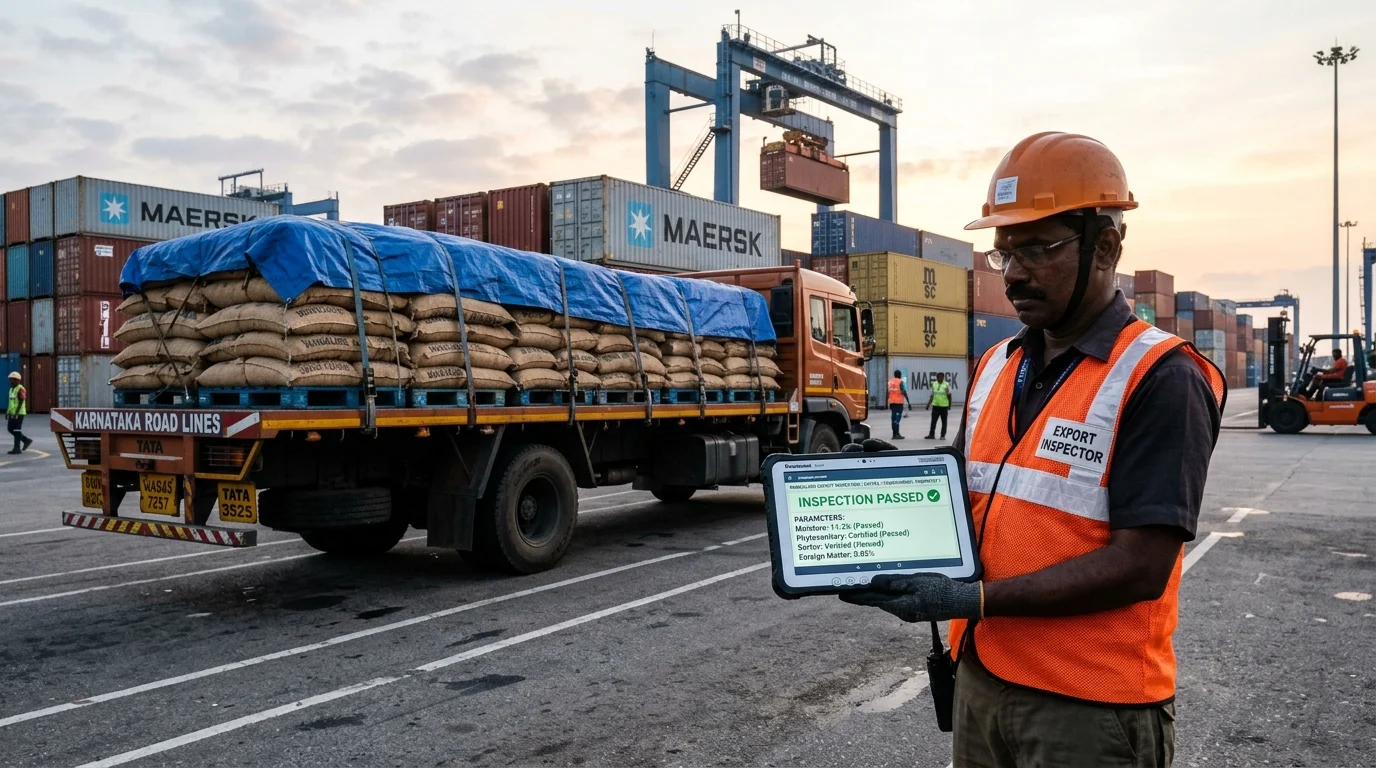
A standard 20-foot Full Container Load (FCL) of Indian green coffee consists of exactly 300 heavy-duty 60kg export jute bags, equating to an 18 Metric Ton (18,000 kg) net coffee payload. Moving this mass safely requires dedicated multi-axle freight carriers fitted with waterproof heavy-gauge canvas tarpaulins and air-suspension tie-downs to prevent sack abrasion, moisture contact, and bag shifting during the 6 to 8 hour mountain descent.
Before cargo can be received at the NMPA container terminal and loaded aboard the ocean vessel under FOB terms, comprehensive statutory documentation and regulatory clearances must be executed seamlessly:
Inland Transit Security Protocol
Draba Ventures coordinates all inland trucking under GPS-tracked fleet management with factory-applied high-security bolt seals. Truck drivers must adhere to non-stop transit corridors between our Chikmagalur curing mills and the port freight station, guaranteeing zero cargo tampering or unauthorized roadside cross-docking.
- Coffee Board of India Export Permit: Statutory mandatory certification issued by the Coffee Board under the Ministry of Commerce & Industry, verifying screen grading, processing method, and statutory export compliance.
- Registration-Cum-Membership Certificate (RCMC): Confirms Draba Ventures as a registered exporter in good standing under the Indian Foreign Trade Policy, authorizing legal international cargo clearing.
- ICO Certificate of Origin: Issued in compliance with International Coffee Organization standards, providing definitive geographic verification required by importing customs authorities for tariff quota determination.
- Phytosanitary Certification: Issued by the Directorate of Plant Protection, Quarantine & Storage following physical lot sampling to verify absolute freedom from agricultural pests, including the Coffee Berry Borer (Hypothenemus hampei).
- ICEGATE Electronic Shipping Bill: Customs export declaration filed through the Indian Customs Electronic Gateway, resulting in the issuance of the official Let Export Order (LEO) permitting container gate-in and vessel loading.
Quality Assurance and Optical Defect Extraction: 94.63% Sortex Precision
A common failure in conventional broker supply chains is attempting to perform optical sorting at shared port-side warehouses or skipping secondary sorting altogether after estate aggregation. At Draba Ventures, all physical grading, vibratory screen classification, and optical defect extraction are finalized 100% inside our precision curing facility prior to cargo dispatch to the port terminal.
Our processing lines integrate state-of-the-art VIS/NIR Hyperspectral Imaging (HSI) Sortex optical sorting machinery, achieving an independently audited 94.63% optical sorting accuracy. Operating across dual visible light (VIS) and near-infrared (NIR) wavelengths, our Sortex sorters inspect every individual bean at speeds exceeding 12,000 beans per minute. This technology instantly identifies and pneumatically ejects subtle physical and chemical imperfections that mechanical sieves miss, including black beans, sour beans, insect-damaged seeds, chipped fragments, and foreign mineral stones.
By completing this advanced optical sorting prior to port transit, we eliminate unnecessary bean handling in humid coastal environments, preserve bean cellular integrity, and ensure that only structurally pristine, export-grade green coffee enters the shipping container.
Moisture Control and Maritime Security: GrainPro Preservation & OTA Prevention
Green coffee is inherently hygroscopic, meaning its cellular structure continuously absorbs and releases ambient water vapour to reach equilibrium with surrounding relative humidity. Coastal port environments like Mangalore, where ambient relative humidity frequently exceeds 75% to 85% during monsoon and coastal morning hours, present a critical hazard for unroasted coffee.
If internal bean moisture rises above 12.5% at tropical ambient temperatures, xerophilic moulds such as Aspergillus ochraceus and Aspergillus carbonarius can proliferate. These fungal strains produce Ochratoxin A (OTA), a dangerous nephrotoxic mycotoxin subject to strict statutory import limits (maximum 3.0 ppb in the European Union under Regulation (EU) 2023/915). An OTA failure results in mandatory port destruction or cargo seizure at destination.
To guarantee absolute maritime security from NMPA berth to destination roastery, all coffee is dried to a strict 10.5% to 11.5% moisture band before packaging, sealed inside multi-layer GrainPro hermetic liners within 60kg export jute bags, and loaded into containers fitted with industrial calcium chloride desiccant poles to eliminate container rain during maritime voyage.
Pre-Pack Target
Strictly 10.5% to 11.5% moisture band; verified by calibrated dielectric moisture analyzers before bagging.
GrainPro Hermetic Liners
Multi-layer co-extruded gastight barrier liners isolating green beans from coastal humidity and atmospheric salt air.
Container Wall Lining
Food-grade kraft liner paper covering floors and sidewalls to prevent direct contact with metal container panels.
Calcium Chloride Desiccants
High-absorption industrial dry poles suspended in container wall recesses to eliminate internal condensation rain.
Frequently Asked Questions: FOB Mangalore Green Coffee Export & Sourcing
Source Direct from Origin on FOB Mangalore Terms
Contact Draba Ventures' green coffee export desk to request firm FOB NMPA pricing, review physical grading specifications, or schedule container loadings.
