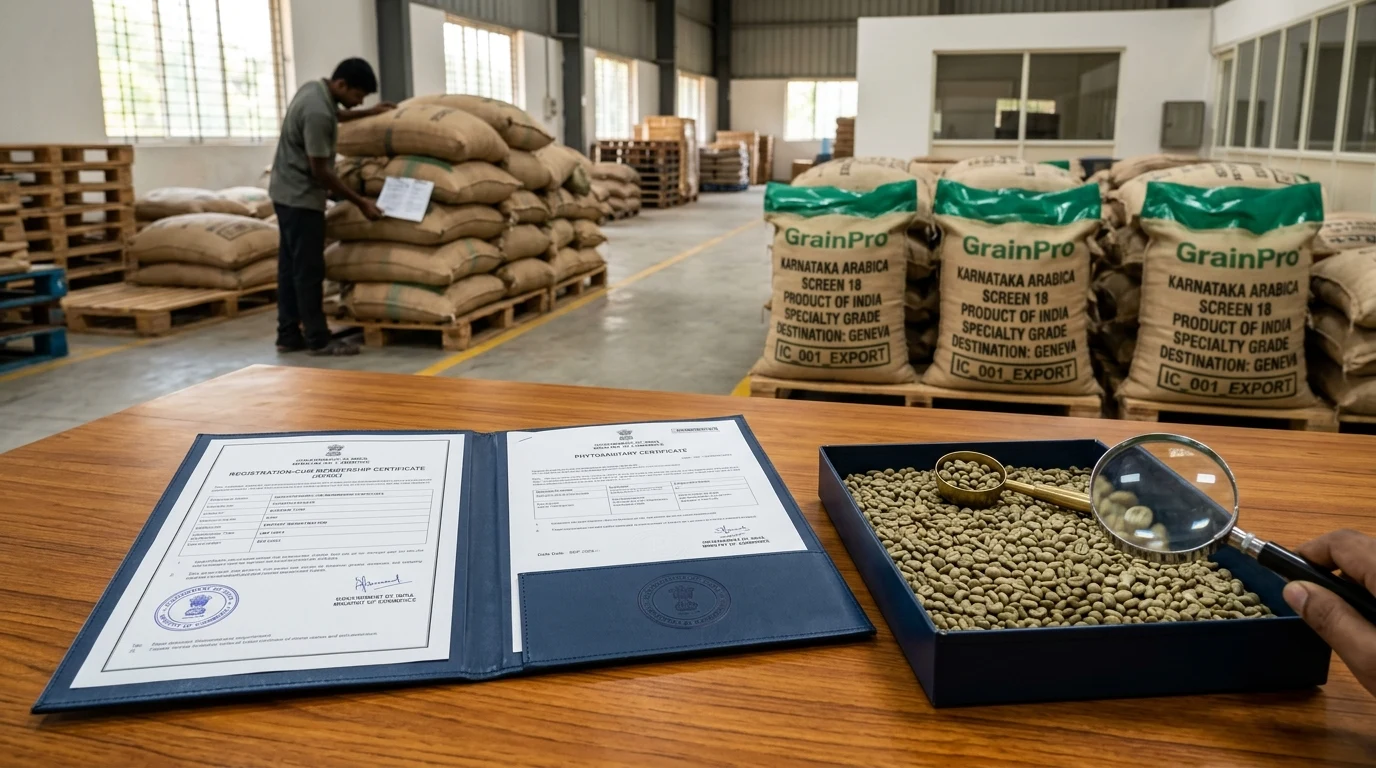
The Coffee Board of India and RCMC Certification: Institutional Export Governance
In cross-border agricultural trade, international roasters and green coffee importers face continuous operational risks when procuring raw materials from non-integrated middlemen or informal spot brokers. In India, coffee is not an unregulated commodity; it is strictly governed by the Coffee Act of 1942 under the administrative control of the Ministry of Commerce and Industry, Government of India. As an established, primary processor and APEDA registered coffee exporter Karnataka, Draba Ventures operates under the rigorous institutional framework of the Coffee Board of India.
The cornerstone of legal green coffee export from India is the Registration-cum-Membership Certificate (RCMC), issued exclusively by the Coffee Board of India. Under Chapter 2 of the Indian Foreign Trade Policy (FTP), no corporate entity can execute outbound commercial coffee shipments, generate statutory International Coffee Organization (ICO) Certificates of Origin, or clear cargo through Indian Customs without an active, validated RCMC credential. This institutional requirement provides international buyers with the legal certainty that their export partner has undergone extensive regulatory scrutiny, financial audit, and operational due diligence by statutory authorities.
When foreign coffee buyers partner with an RCMC-certified export processor like Draba Ventures, the commercial contract benefits from complete legal transparency. Every containerized lot dispatched from our curing facilities in Chikmagalur and Hassan is backed by statutory Coffee Board Export Permits. These permits confirm that the cargo strictly conforms to official Indian grade schedules (such as Mysore Nuggets Extra Bold, Plantation A, or Robusta Cherry AB), eliminates the danger of counterfeit origin claims, and ensures full audit-trail compliance from the curing mill gate to the vessel rail at New Mangalore Port Authority (NMPA).
Statutory RCMC Licensing
Officially licensed under the Coffee Board of India, Ministry of Commerce & Industry, validating legitimate corporate export authorization.
ICO Certificate of Origin
Direct issuance of International Coffee Organization (ICO) origin credentials for preferential tariff quotas and customs classification.
Export Permit Verification
Mandatory batch-level Coffee Board export inspection permits verifying official screen grade, processing method, and lot authenticity.
Direct Curing Auditability
Comprehensive estate-level audit trails and curing mill documentation eliminating intermediary broker opacity and speculative spot risk.
APEDA Registration and Global Customs Trust: Fast-Tracking International Clearance
While the Coffee Board of India governs internal crop architecture and commodity-specific export licensing, the Agricultural and Processed Food Products Export Development Authority (APEDA) serves as India's apex export promotion and food safety regulatory organization. Holding official APEDA registration distinguishes Draba Ventures as a multi-category agricultural exporter equipped to meet the world's most stringent import barriers, SPS (Sanitary and Phytosanitary) protocols, and environmental mandates.
International coffee clearance has entered a new era of regulatory rigor. Importing authorities in the European Union, the United Kingdom, the United States (FDA / USDA), the Middle East (SFDA), and the Russian Federation (Roselkhoznadzor) require indisputable documentation proving that agricultural imports are free from quarantine pests, chemical contaminants, and unauthorized pesticide residues. Our official APEDA registration integrates directly into the Indian Customs Electronic Gateway (ICEGATE) and the Plant Quarantine Information System (PQIS), expediting the issuance of genuine Phytosanitary Certificates issued by the Directorate of Plant Protection, Quarantine & Storage.
Statutory Customs Facilitation Protocols
Through our synchronized APEDA and Coffee Board credentials, Draba Ventures provides foreign buyers with seamless single-window documentation. Every Full Container Load (FCL) includes certified ICO Certificates of Origin, phytosanitary clearance verifying complete absence of the Coffee Berry Borer (Hypothenemus hampei), Eurofins chemical screening reports confirming Maximum Residue Limits (MRL) compliance, and digital GPS polygon coordinates ensuring full alignment with EUDR (Regulation (EU) 2023/1115).
For European buyers navigating the European Union Deforestation Regulation (EUDR), buying from an unverified broker creates extreme legal exposure. Under EUDR, importers face severe financial penalties and port entry bans if coffee lots cannot be traced to geo-referenced estate polygons with verified non-deforestation baselines post-December 31, 2020. Draba Ventures combines APEDA institutional trust with polygon geolocation mapping across certified shade-grown estates in Karnataka, providing European roasters with bulletproof due diligence statements that pass competent authority audits on arrival.
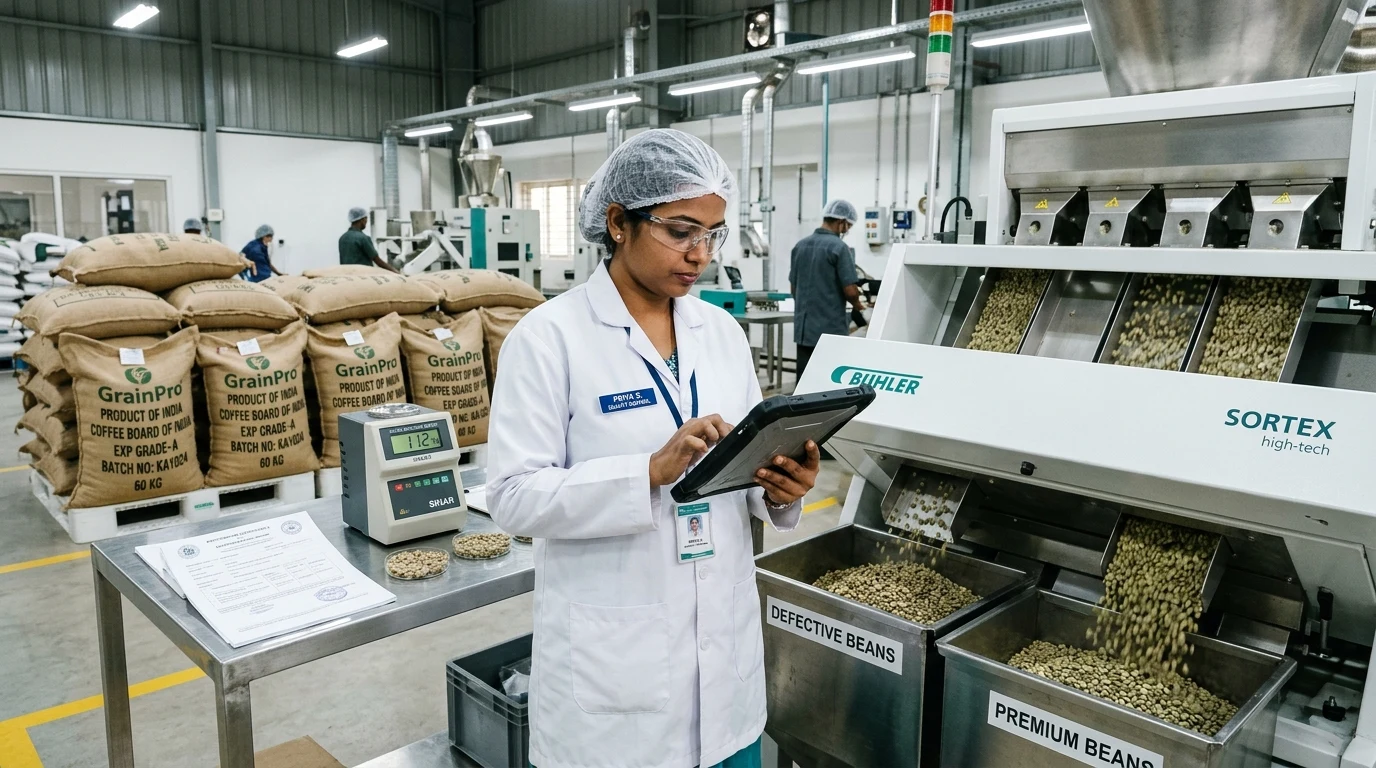
Quality Assurance and Optical Defect Extraction: Exceeding Statutory Baseline Tolerances
Securing an export license is only the foundation of global trade; fulfilling the commercial expectations of specialty roasters requires engineering excellence at the curing mill. The Coffee Board of India establishes statutory baseline standards for bean sizing, moisture content, and permissible defect counts for standard commercial grades. However, for discerning international buyers, baseline tolerances are insufficient to protect sample roaster calibrations and high-end espresso extractions.
At Draba Ventures, all physical grading, mechanical screen classification, and optical defect extraction are completed inside our high-precision curing mill prior to containerization. We integrate advanced VIS/NIR Hyperspectral Imaging (HSI) Sortex optical sorting machinery, achieving an independently verified 94.63% optical sorting accuracy. While conventional sorting relies purely on mechanical rotary screens and standard monochromatic sensors, our VIS/NIR technology inspects green coffee beans simultaneously across visible and near-infrared spectral wavelengths at speeds exceeding 12,000 beans per minute.
| Quality Parameter | Statutory Coffee Board Minimum | Draba Ventures Export Standard | Commercial Importer Advantage |
|---|---|---|---|
| Optical Sorting Technology | Basic mechanical gravity & sieving | VIS/NIR Hyperspectral Sortex (94.63%) | Zero primary defects; uniform roast profiles |
| Primary Defect Tolerance | 1.5% - 3.0% by weight (grade dependent) | 0% primary defects (Grade 1 / Specialty) | Eliminates quakers, black, and sour cup taints |
| Foreign Matter / Minerals | Max 0.25% - 0.50% permitted | 0.00% (triple magnetic & optical pass) | Protects industrial grinder burrs and equipment |
| Screen Size Consistency | 70% - 85% retained on primary screen | 90%+ retained on Screen 18 / 19 | Identical convective heat transfer during roasting |
| Moisture Level at Packing | Statutory ceiling of 12.0% | Strictly calibrated 10.5% - 11.5% | Inhibits fungal growth and OTA formulation |
Our dual-spectrum optical extraction system instantly detects and pneumatically ejects subtle internal and external defects that escape traditional sizing sieves. This includes insect-damaged beans (berry borer pinholes), immature quakers, sour fermentations, chipped beans, and foreign mineral fragments. By finalizing optical purification at origin, we ensure that every 60kg export sack delivered under our APEDA registration delivers consistent bulk density, pristine bean structure, and an unblemished cup.
Moisture Control and Maritime Security: GrainPro Hermetic Preservation & OTA Prevention
Phytosanitary certification is not merely a bureaucratic stamp; it is a critical biochemical safeguard against maritime cargo spoilage. Green coffee is naturally hygroscopic, actively absorbing and desorbing moisture in response to ambient relative humidity. During ocean transit from New Mangalore Port Authority (NMPA) through tropical shipping routes (such as the Arabian Sea, the Red Sea, or the Indian Ocean), containers experience drastic thermal fluctuations and high ambient humidity, frequently exceeding 80% RH.
When unroasted green coffee is exposed to moisture levels above 12.5% in warm maritime environments, xerophilic moulds, particularly Aspergillus ochraceus and Aspergillus carbonarius, can proliferate rapidly. These moulds produce Ochratoxin A (OTA), a dangerous nephrotoxic and carcinogenic mycotoxin subject to rigorous statutory enforcement globally. In the European Union, Regulation (EU) 2023/915 establishes a strict statutory limit of maximum 3.0 parts per billion (ppb) for green coffee. Shipments testing above this threshold face immediate mandatory port rejection, destruction, or re-export at immense cost to the buyer.
To eliminate ocean transit risks and guarantee total phytosanitary security, Draba Ventures enforces an uncompromising moisture control protocol. Every coffee lot is systematically dried to a tight 10.5% to 11.5% moisture band before packaging. Beans are hermetically sealed in multi-layer, gas-tight GrainPro protective liners within heavy-duty 60kg jute bags. When stuffed into 20-foot Full Container Loads (FCL) carrying 18 Metric Tons (300 bags), containers are fitted with industrial calcium chloride desiccant poles and food-grade barrier liners. This maritime barrier protocol guarantees that the coffee arrives at destination roasteries in identical sensory and biochemical condition as when it departed our Karnataka facilities.
Dielectric Moisture Audit
Every curing lot is dried to a controlled 10.5% - 11.5% moisture band, verified with ISO-calibrated digital capacitance analyzers.
GrainPro Hermetic Liners
Sealed inside multi-layer, gas-tight GrainPro liners inside 60kg export jute bags to lock in green bean cellular integrity.
Container Rain Defense
Deployment of industrial calcium chloride desiccant dry-poles and kraft container liners to prevent condensation drips during ocean transit.
Zero Quarantine Rejection
Pre-shipment Eurofins mycotoxin and pesticide residue validation guaranteeing 100% first-time clearance at destination border posts.
Frequently Asked Questions
Partner with an APEDA Registered Coffee Exporter in Karnataka
Source high-grade Indian Arabica and Robusta green coffee backed by official Coffee Board RCMC licensing, complete phytosanitary compliance, and transparent FOB/CIF pricing.
