The Rotterdam Gateway: A Zero-Tolerance Ecosystem
As the primary logistical artery into the European Union, the Port of Rotterdam handles millions of tonnes of agri-commodities. However, the Netherlands Food and Consumer Product Safety Authority (NVWA) operates a zero-tolerance policy for chemical non-compliance on Indian rice imports.
When a container of Sona Masoori or Basmati arrives, it is subjected to immediate targeted sampling. If pesticide residues or mycotoxins exceed the European Commission's limits, the cargo is detained, triggering catastrophic demurrage costs.
Important Note
European authorities actively share data via the Rapid Alert System for Food and Feed (RASFF). A single border rejection at Rotterdam blacklists the specific exporter across all 27 EU member states instantly.
The Big Three: What Rotterdam Tests For
Our compliance teams track the specific chemical targets prioritized by NVWA laboratories during rice inspections:
| Contaminant Category | Specific Targets | EU Maximum Limit |
|---|---|---|
| Fungicides | Tricyclazole, Carbendazim | 0.01 mg/kg (ppm) |
| Mycotoxins | Aflatoxin B1, Ochratoxin A | 2.0 μg/kg (Aflatoxin B1) |
| Heavy Metals | Inorganic Arsenic, Lead | 0.20 mg/kg (Arsenic) |
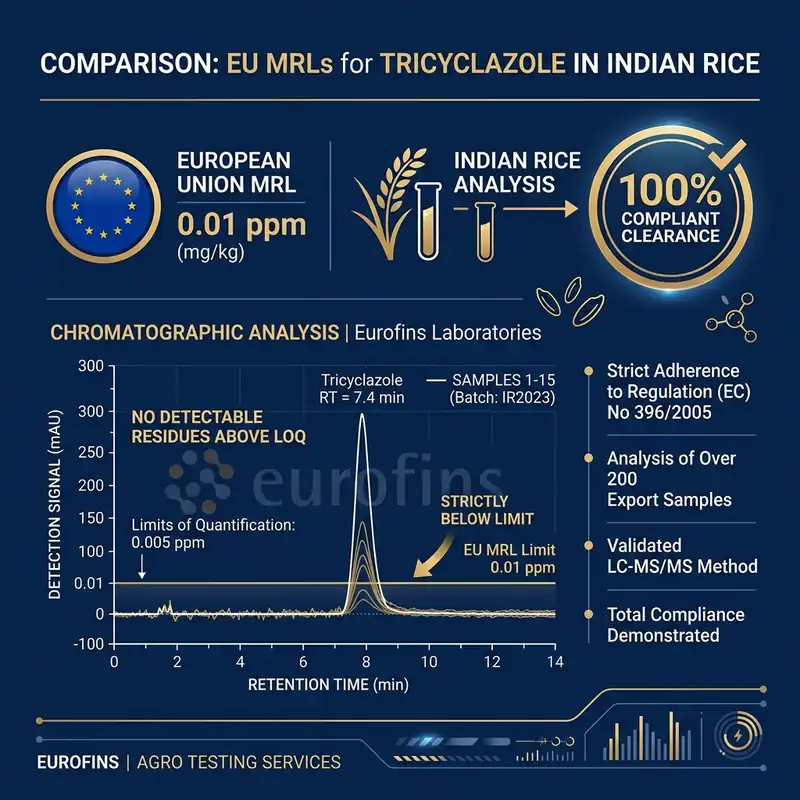
Pre-Clearance Through Eurofins India
Gambling on post-arrival testing is not a viable business model for EU importers. Draba Ventures utilizes a "mirror testing" protocol. Before a container is sealed in India, samples are drawn and subjected to liquid chromatography-mass spectrometry (LC-MS/MS) via Eurofins laboratories.
We test for the exact matrices the NVWA will test for. When our containers land in Rotterdam, they arrive with pre-verified Certificates of Analysis, ensuring swift customs clearance and immediate access to the European distribution network.
Protect your European supply chain from border rejections. Tap the WhatsApp icon below to discuss our lab-certified CIF Rotterdam pricing.
