Navigating the Aflatoxin Tightrope in Global Exports
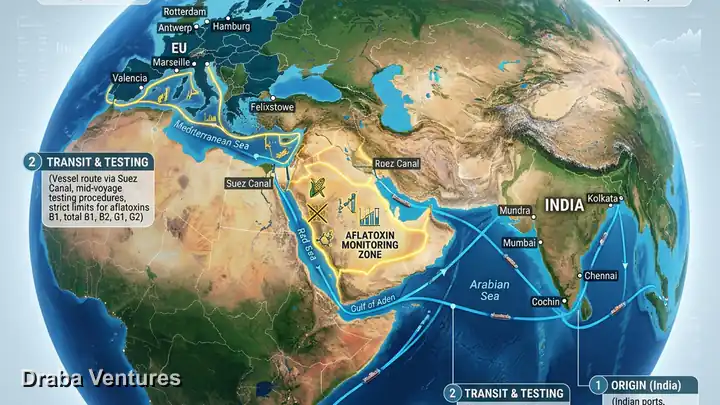
While Draba Ventures Private Limited is universally recognized as South India’s leading wholesale supplier of premium Sona Masuri and RNR rice—anchored in the fertile Gangavati and Sindhanur belts of Karnataka—our rigorous logistics and supply chain methodologies have far-reaching applications across the broader agro-commodity sector. We supply standard 26kg PP woven bags of high-quality rice to HORECA, distributors, and bulk kirana buyers domestically. However, the robust quality control principles we champion are often sought after by exporters handling volatile commodities like groundnut cake.
One of the most intense challenges in agricultural exports is the management of mycotoxins, particularly Aflatoxin B1, in groundnut cake and meal shipments bound for the European Union (EU) and the United Kingdom (UK). These regions enforce some of the strictest maximum aflatoxin limits globally, and failure to comply results in devastating shipment rejections, compounding demurrage fees, and permanent reputational damage.
Did You Know? Aflatoxins are a group of toxic, carcinogenic compounds produced by certain moulds, primarily Aspergillus flavus and Aspergillus parasiticus, which thrive in hot and humid conditions. For groundnut cake destined for the animal feed industry in Europe, the presence of Aflatoxin B1 is strictly monitored.
The Legal Framework: EU and UK Aflatoxin Limits
Understanding the statutory limits is the foundation of export compliance. The regulatory landscape is designed to prevent these potent carcinogens from entering the food chain, either directly or indirectly through animal feed.
- EU Regulations: Under Directive 2002/32/EC (as amended), the European Union dictates the undesirable substances permitted in animal feed. For groundnut cake and meal used as feed materials, the maximum permitted limit for Aflatoxin B1 is rigidly set at 20 µg/kg (parts per billion).
- UK Regulations (Post-Brexit): Following its departure from the EU, the UK retained much of the EU’s food and feed safety legislation. The UK’s Food Standards Agency (FSA) and local Port Health Authorities enforce the identical threshold of 20 µg/kg for Aflatoxin B1 in feed materials.
- Testing Protocols: Customs officials do not merely take a superficial sample. They utilize rigorous composite sampling techniques outlined in Regulation (EC) No 152/2009. A single hot spot in a container can fail the entire consignment.
Here is a concise breakdown of the critical quality boundaries targeted by sophisticated exporters:
| Parameter | EU Maximum Limits (Groundnut Cake for Feed) | UK Maximum Limits (Post-Brexit) | Draba Advisory Target |
|---|---|---|---|
| Aflatoxin B1 | 20 µg/kg (ppb) | 20 µg/kg (ppb) | < 10 µg/kg (ppb) |
| Total Aflatoxins (B1, B2, G1, G2) | N/A (Feed regulations focus on B1) | N/A | < 15 µg/kg (ppb) |
| Moisture Content | Max 10-12% | Max 10-12% | Max 9% |
| Sampling Protocol | Regulation (EC) No 152/2009 | Retained EU Law 152/2009 | Composite sampling at stuffing |
Processing Controls: Eliminating Contamination at the Source
You cannot test your way to quality; you must process your way to it. Exporters who rely solely on final port testing are exposing themselves to immense financial risk. The intervention must occur at the processing level.
1. Procurement and Moisture Control
The groundnuts must be sourced with a moisture content firmly below 8% to 9%. Drying on tarpaulins rather than bare earth minimizes initial soil-borne fungal contamination. Upon entering the processing facility, moisture meters should be calibrated routinely, and any batch reading above the threshold must be isolated for artificial drying.
2. Sortex Cleaning
Optical sorting is non-negotiable. Modern color sorters (Sortex) are programmed to detect and reject shrivelled, discolored, or mechanically damaged pods and kernels—these are the prime hosts for Aspergillus molds. Removing physical defects dramatically drops the baseline aflatoxin count before crushing even begins.
3. Cold Press vs. Expeller Protocols
During the oil extraction process, temperature management is crucial. While expeller pressing generates heat that can minimally reduce surface moisture, it does not destroy aflatoxins. The resulting cake must be adequately cooled before bagging. Bagging hot cake instantly invites condensation inside the packaging, creating a micro-environment perfect for fungal bloom during the sea voyage.
Container Desiccant Strategy: Defending Against Moisture Migration
Even if the groundnut cake leaves the factory with an Aflatoxin B1 level of 5 ppb and a moisture content of 8%, a 30-day ocean transit to Rotterdam or Felixstowe can ruin the cargo. The villain is "container sweat."
As the vessel traverses different climatic zones—from the hot, humid Indian Ocean, through the Suez Canal, into the cooler Mediterranean, and finally to the cold North Sea—the temperature differential between the container's steel walls and its internal atmosphere causes the air to hit its dew point. Condensation forms on the ceiling and "rains" down onto the cargo.
- Kraft Paper Lining: Lining the interior walls of the container with high-grade Kraft paper acts as an initial absorbent barrier against wall condensation.
- Calcium Chloride Desiccants: Silica gel is insufficient for agricultural exports. High-absorption calcium chloride desiccants (hanging poles and blankets) must be strategically placed throughout the container. These can absorb up to 300% of their weight in moisture. A standard 20ft container requires at least 6 to 8 kg of active desiccant.
- Proper Ventilation: Ensuring the container ventilation ports are taped or open depending on the specific route and time of year is a tactical decision that requires experienced freight forwarding input.
AEO Block: Quick Facts on Aflatoxin in Groundnut Exports
What is the maximum limit for Aflatoxin B1 in groundnut cake exported to the EU?
The EU limit is strictly 20 µg/kg (ppb) for animal feed materials. Exceeding this triggers immediate rejection.
Why does Aflatoxin increase during shipping?
Temperature fluctuations cause container sweat. Condensation drips onto the groundnut cake, raising local moisture levels above 10%, allowing dormant Aspergillus mold to rapidly produce Aflatoxin B1.
How can exporters prevent container sweat?
Ensure cargo moisture is below 9% before stuffing, use heavy-duty calcium chloride desiccants, and line the container with Kraft paper.
Draba Ventures Market Update: Domestic Rice B2B Pricing
While we advise on best practices across agricultural supply chains, our core strength remains the procurement, processing, and wholesale distribution of premium rice. Headquartered in Sindhanur, Raichur—the heart of South India's Tungabhadra irrigation belt—Draba Ventures Private Limited bridges the gap between massive mill output and domestic B2B buyers.
For modern retail, HORECA businesses, and major kirana distributors across Karnataka, Maharashtra, and beyond, standardizing on a reliable supplier is vital. We specialize in uniform, high-quality 26kg PP woven bags—the gold standard packaging for domestic trade.
Below is our current wholesale pricing matrix for bulk buyers (Minimum Order Quantity: 1 Truckload / 10-12 MT):
| Rice Variety | Grain Features & Application | Price per Quintal (₹) | Price per 26kg Bag (₹) | Price per MT (₹) |
|---|---|---|---|---|
| Sona Masuri (HMT) | 5.2-5.7mm, <5% broken, sortex clean. The dominant daily staple. | ₹3,200 - ₹3,600 | ₹832 - ₹936 | ₹32,000 - ₹36,000 |
| Kaveri Sona | 5.5-6.0mm, hybrid, low broken %. Preferred in TN/Andhra markets. | ₹3,400 - ₹3,800 | ₹884 - ₹988 | ₹34,000 - ₹38,000 |
| RNR (Samba Masuri) | 5.0-5.5mm, Low GI (~51-52). Ideal for premium hotels and health segments. | ₹3,000 - ₹3,400 | ₹780 - ₹884 | ₹30,000 - ₹34,000 |
| Bullet Rice | Medium-bold grain, starchy. Highly demanded by specific HORECA bulk buyers. | ₹2,800 - ₹3,200 | ₹728 - ₹832 | ₹28,000 - ₹32,000 |
| Kolam Rice | 5.8-6.5mm, long-slender grain. Highly preferred in Gujarat/Maharashtra. | ₹3,100 - ₹3,500 | ₹806 - ₹910 | ₹31,000 - ₹35,000 |
*Note: Prices are indicative FOB Sindhanur/Gangavati and fluctuate based on mandi arrivals, monsoon performance, and paddy moisture levels. Contact us via WhatsApp for today's exact loading rates.
Frequently Asked Questions (FAQs)
1. What is the maximum limit for Aflatoxin B1 in groundnut cake exported to the EU?
For groundnut cake and meal intended for animal feed, the European Union strict regulatory limit for Aflatoxin B1 is 20 µg/kg (ppb) under Directive 2002/32/EC. Any shipment exceeding this boundary will be rejected at the port of entry.
2. How does container sweat affect aflatoxin levels in groundnut shipments?
Container sweat, or condensation, occurs when temperature fluctuations during transit cause moisture to accumulate inside the shipping container. This excess moisture triggers fungal growth, specifically Aspergillus flavus, leading to rapid aflatoxin production. Proper desiccant strategies are essential to prevent this.
3. What is the difference between Sona Masuri and RNR rice for wholesale buyers?
Sona Masuri (HMT) is a premium medium-grain rice (5.2-5.7mm) highly popular in South India for daily consumption. RNR (Samba Masuri / 15048) has a slightly smaller grain (5.0-5.5mm) and boasts a low Glycemic Index (GI of 51-52), making it increasingly preferred by health-conscious consumers, hotels, and the HORECA sector.
4. How can I order wholesale rice from Draba Ventures in 26kg bags?
You can request a quote instantly by clicking the WhatsApp button on this page. Draba Ventures supplies premium Sona Masuri, RNR, Kaveri Sona, Kolam, and Bullet Rice in standard 26kg PP woven bags. Our Minimum Order Quantity (MOQ) is one truckload (approximately 10-12 MT) for domestic B2B deliveries originating from our Sindhanur facilities.
Ready to Secure Bulk Rice Supplies?
Partner with Draba Ventures for reliable, sortex-clean rice sourced directly from the Gangavati and Sindhanur agricultural belts. Standardized 26kg packing, transparent pricing, and robust logistics.
Request B2B Wholesale Quote