Industrial instant coffee manufacturing operates on razor-thin processing margins where fractional variations in soluble solid yield determine commercial viability. For multinational food conglomerates, instant coffee packers, and soluble processing facilities, raw material procurement requires strict consistency in bulk density, moisture equilibrium, and mechanical purity. As an established soluble grade green coffee supplier in India, Draba Ventures delivers high-density Indian Robusta and Arabica lots engineered specifically for maximum extraction efficiency across spray-drying, agglomeration, and freeze-drying operations.
High-Yield Extraction for Soluble Manufacturing
The fundamental metric of instant coffee unit economics is the extraction yield percentage (soluble solids recovered relative to green coffee mass loaded into the percolation battery). Generic commercial coffees with erratic density distributions or elevated moisture yield inconsistent extraction kinetics, requiring increased thermal energy, higher column pressures, and extended cycle times that degrade volatile aromatic compounds.
Indian Robusta (predominantly Cherry AB, Cherry C, and washed Parchment grades grown at elevations between 500 and 1,200 meters in Karnataka and Kerala) delivers an exceptionally high natural concentration of water-soluble polysaccharides, chlorogenic acids, and caffeine. When processed through continuous multi-stage counter-current percolation batteries, high-density Indian Robusta routinely achieves 38% to 44% soluble solid extraction yields:
- Thermal Hydrolysis Resistance: Dense cellular wall structures allow high-temperature hydrolysis (up to 180 degrees Celsius) in secondary extraction columns without excessive carbohydrate degradation, ensuring optimal body and yield.
- Evaporator Efficiency: A higher concentration of native dissolved solids entering the falling-film evaporators reduces the steam load required to concentrate the liquor to 45% to 50% solids prior to drying.
- Freeze-Drying Granule Integrity: High natural solids content enhances crystalline structure formation in freeze-drying freezing belts, minimizing friability and fine powder losses during vacuum sublimation.
- Spray-Drying Powder Bulk Density: Predictable feed viscosities yield uniform atomization in spray-drying towers, delivering consistent bulk density (220 to 260 g/L) for high-speed retail jar and sachet filling lines.
| Raw Material Parameter | Draba Ventures Industrial Soluble Grade | Generic Broker Bulk Shipment | Operational Impact on Processing Plant |
|---|---|---|---|
| Soluble Solid Yield | 38.5% - 43.8% Total Yield | 32.0% - 36.5% Total Yield | Reduces raw green coffee volume required per metric ton of finished soluble powder. |
| Bulk Bean Density | 680 - 740 g/L (Calibrated) | 590 - 640 g/L (Variable) | Prevents column channeling and maintains uniform hydraulic pressure drops. |
| Optical Sortex Precision | 94.63% Defect & Stone Removal | Standard Gravity Screen Only | Prevents catastrophic roller grinder tooth fractures and downtime. |
| Moisture Content | 10.5% - 11.5% (Max 12.0%) | 12.5% - 14.0% (Unregulated) | Prevents microbial hydrolysis, mold formation, and Ochratoxin A (OTA) risk. |
| Foreign Matter (Stones/Metal) | 0.00% Guaranteed Foreign Matter | Up to 0.15% Incidental Debris | Eliminates risk of costly manufacturing line shutoffs and valve clogging. |
Securing Margins for Industrial Conglomerates
Soluble coffee production facilities process immense raw material volumes, consuming hundreds of metric tons per month to satisfy retail, vending, and institutional contracts. In high-volume operations, relying on spot-market commodity brokers introduces volatile pricing layers, unhedged currency exposure, and unpredictable supply disruptions.
Draba Ventures resolves these supply vulnerabilities through direct-trade volume agreements originating at state-of-the-art curing mills in Karnataka:
- Elimination of Broker Markups: Procuring directly on Free On Board (FOB New Mangalore/Cochin) or Cost, Insurance, and Freight (CIF) terms bypasses international middle-tier trading desks, preserving 6% to 14% procurement margins.
- Scheduled Container Allocations: Multi-container contracts (10 to 50 FCL commitments) are scheduled in systematic monthly or bi-weekly shipments, ensuring manufacturing silos maintain constant buffer stocks without excessive factory warehousing overhead.
- Flexible Export Packaging Formats: Green coffee is shipped in 60kg jute bags with GrainPro liners, 1,000kg bulk big bags (FIBC), or 20ft container bulk liners (stuffing up to 21.6 MT per container), minimizing handling labor at your receiving hopper.
- Statutory Origin Documentation: Complete export dossiers include official Coffee Board of India Registration-cum-Membership Certificates (RCMC), Phyto clearances, and Chamber of Commerce Certificates of Origin for preferential tariff clearance.
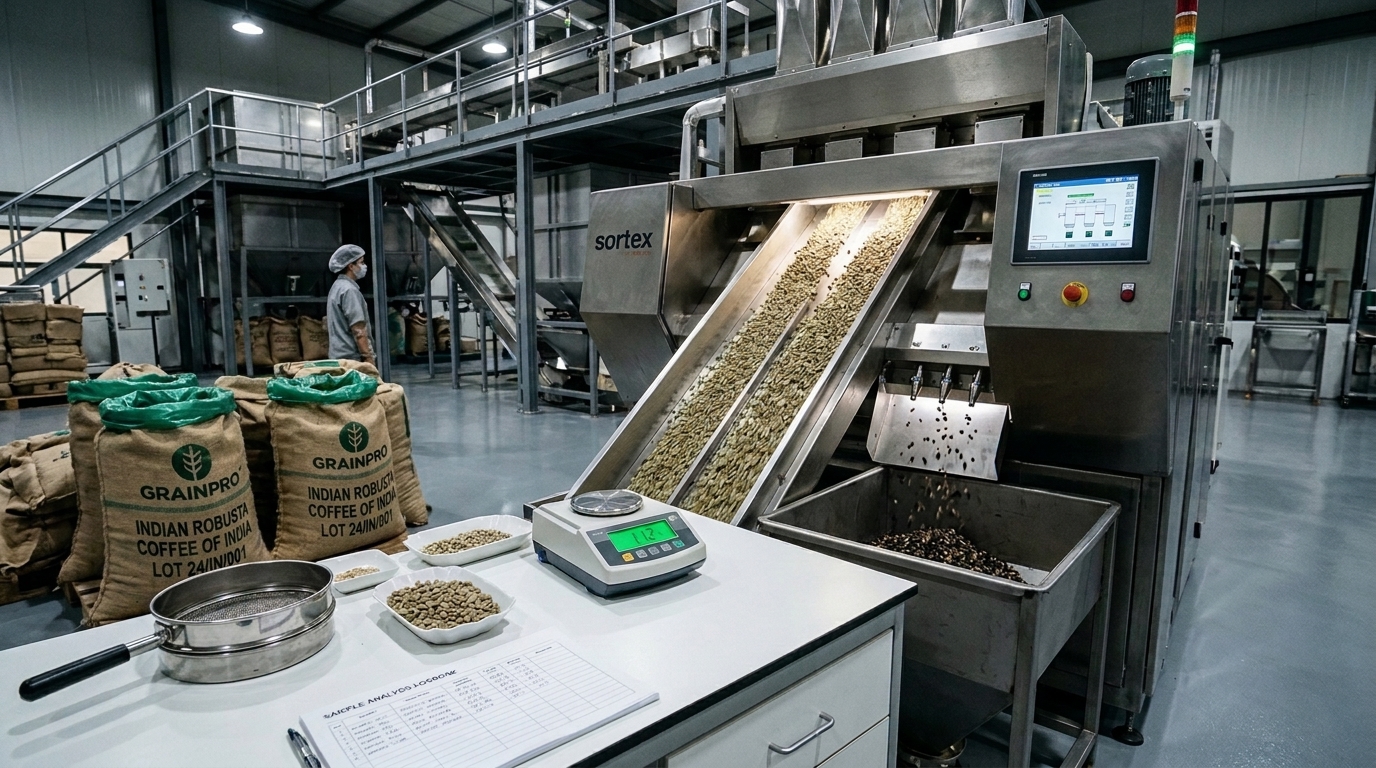
Quality Assurance and Optical Defect Extraction
In an industrial soluble processing facility, green coffee is passed through massive high-torque roller mills or multi-stage flaking grinders before entering extraction percolators. The presence of even a single foreign stone or metallic inclusion can shear expensive hardened steel roller teeth, causing tens of thousands of dollars in mechanical damage and halting continuous extraction cycles.
To guarantee complete mechanical security, Draba Ventures subjects all soluble grade green coffee lots to comprehensive multi-pass mechanical and optical cleaning:
- Pre-Cleaning and Destoning: Multi-deck vibratory screens remove oversize twigs and fine dust, followed by negative-pressure pneumatic gravity destoners that eliminate heavy stones and mineral fragments based on specific gravity differentials.
- Magnetic Rare-Earth Separation: High-intensity neodymium magnetic grids extract all ferrous particles, wire pieces, and metallic debris before sorting.
- VIS/NIR Hyperspectral Sortex Separation: High-speed optical sorting machines operating with VIS (visible) and NIR (near-infrared) cameras achieve 94.63% defect extraction accuracy, identifying and ejecting black beans, insect-damaged seeds, discolored seeds, and residual stones at speeds exceeding 5 metric tons per hour.
- Uniform Screen Calibration: Consistent bean sizing prevents fines from blinding percolation screens, ensuring clean hydrodynamic flow and preventing pressure build-up within the extraction column battery.
Moisture Control and Maritime Security
Industrial soluble manufacturing requires green coffee free from mold contamination, enzymatic degradation, and mycotoxins. Ocean freight across tropical maritime corridors exposes bulk container shipments to severe diurnal temperature swings, creating container sweat that can raise surface bean moisture and trigger rapid mold incubation.
Draba Ventures eliminates maritime moisture risks through stringent pre-shipment protocols:
- Strict Moisture Ceiling: Bean moisture is verified via calibrated digital capacitance meters to guarantee levels strictly below 12.0% (target range 10.5% to 11.5%). This limits free water activity to below 0.65 aw, halting biochemical degradation.
- Hermetic GrainPro Liners: Lots packaged in 60kg export bags or 1,000kg big bags incorporate multi-layer gas-tight and moisture-tight hermetic liners. These barriers insulate the beans from humid ambient marine air and eliminate condensation damage.
- Ochratoxin A (OTA) Prevention: Keeping relative humidity within the packaging below 65% permanently suppresses Aspergillus ochraceus and Penicillium verrucosum, ensuring finished instant coffee powders remain comfortably below strict EU (3.0 ppb) and international OTA maximum residue limits.
- Ventilated Containerization: Containers loaded at New Mangalore Port (NMPA) are fitted with moisture desiccant poles and cardboard wall linings to absorb residual interior humidity during transit across the Indian Ocean and Red Sea corridors.
