To successfully import rice into Lagos, traders must aggressively manage Central Bank of Nigeria (CBN) Form M approvals, hedge Naira currency volatility, and optimize Apapa port clearance to avoid crushing demurrage. A top-tier rice export company to Nigeria structures collateralized trade finance instruments to absorb FX shocks, ensuring uninterrupted logistics at Tin Can Island.
Regulatory Framework: Form M and Customs Valuation
The Nigeria Customs Service (NCS) and the CBN maintain rigorous oversight over food imports to manage foreign exchange reserves. Before a single container is loaded in India, the Nigerian importer must initiate an electronic Form M through an Authorized Dealer Bank.
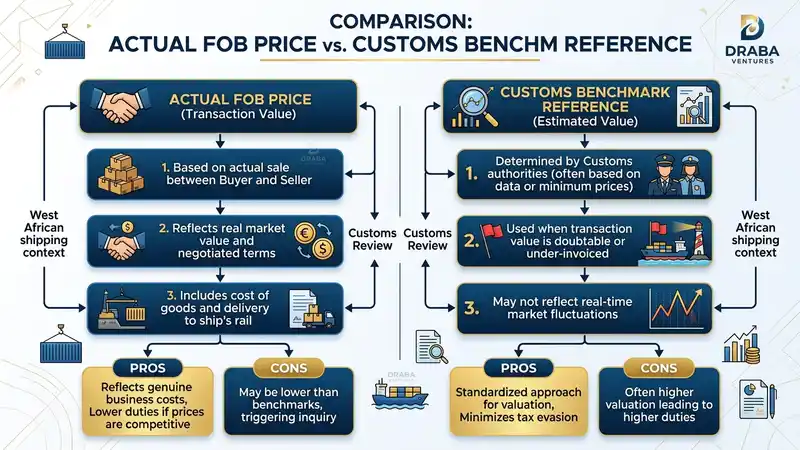
Once the proforma invoice is validated, a Pre-Arrival Assessment Report (PAAR) is generated. Exporters must be aware that NCS frequently applies benchmark valuations (regardless of the commercial invoice) to assess tariffs. (For a deep dive into benchmark pricing, see our guide on Customs Reference Risk).
Financial Settlement & FX Volatility
The widest operational gap in Nigerian trade is currency risk. Importers buy in USD but sell in Naira.
| Financing Instrument | Risk Mitigation | Operational Speed |
|---|---|---|
| Confirmed Irrevocable LC at Sight | Eliminates exporter payment risk entirely. | Slow (Subject to CBN dollar liquidity). |
| Collateralized TT (Telegraphic Transfer) | Requires strong offshore liquidity or hedging. | Fast (Immediate document release). |
To model the impact of delayed LC negotiation on your working capital, leverage our Cost Calculator.
Port Discharge Logistics: Apapa & Tin Can Island
The physical realities of Apapa port grain clearance cost dictate profitability. Apapa and Tin Can Island ports suffer from chronic congestion. A 20ft container sitting on the terminal incurs heavy daily demurrage.
Draba Ventures coordinates closely with local clearing agents to ensure that original Bills of Lading, PAAR documents, and SONCAP (Standards Organisation of Nigeria Conformity Assessment Program) certificates are fully processed days before the vessel docks. We also analyze the economics of containerized shipments versus chartered bulk vessel discharge for ultra-large volume clients.
Draba Execution
We provide flawlessly aligned shipping documents that match the Form M PAAR exactly. This zero-discrepancy protocol prevents customs seizures and accelerates port evacuation timelines in Lagos.
