Customs agencies in West Africa (e.g., GRA in Ghana, Nigeria Customs) frequently override declared commercial invoices using pre-set "Benchmark Reference Values" for duty calculation. If global commodity prices crash, importers are forced to pay duties on outdated, higher reference prices, destroying landed CIF economics. Draba Ventures mitigates this through dynamic Tariff-Sharing Clauses.
The Mechanics of Customs Reference Pricing
In many West African ports, customs authorities combat chronic under-invoicing by applying a minimum valuation database. For agricultural commodities like rice and sugar, this means import duties are not calculated on the actual transaction value (your commercial invoice), but on a state-mandated Reference Value.
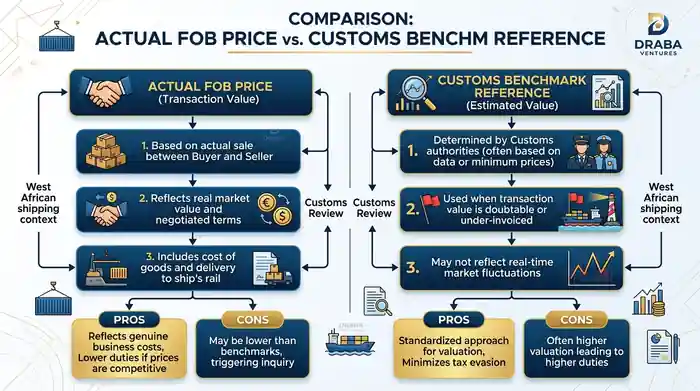
Consider a scenario where the global FOB price of Indian IR64 5% Broken Rice drops from $550/MT to $480/MT. If the destination port's customs database has not been updated and still holds the benchmark at $550/MT, the importer will pay a 20% import tariff on $550, not $480. This artificial valuation instantly erodes the importer's local market competitiveness.
Mathematical Impact on Landed CIF Margins
To understand the severity, we must calculate the exact margin erosion using our standard freight logic. (For real-time logistics math, see our Cost Calculator).
| Metric | Actual Invoice Scenario | Customs Benchmark Scenario | Variance |
|---|---|---|---|
| FOB Invoice Price | $480 / MT | $550 / MT (Assessed) | +$70 Assessment |
| Import Duty (20%) | $96 / MT | $110 / MT | +$14 / MT (Lost Margin) |
| VAT (15% on Duty+Value) | $86.40 / MT | $99.00 / MT | +$12.60 / MT (Lost Margin) |
In the above model, the importer absorbs a total of $26.60 per MT in unexpected tax liabilities simply because the customs reference value was misaligned with the global spot market.
Mitigating Risk: The Price-Adjustment & Tariff-Sharing Framework
To protect capital, institutional buyers must embed specialized clauses into their sales contracts prior to LC issuance.
1. The Duty-Variance Sharing Clause
This clause stipulates that if destination customs assess the cargo at a value greater than 5% above the commercial invoice, the resulting excess duty burden is split (typically 70/30 or 50/50) between the importer and the exporter. This requires the exporter to lower the subsequent shipment's FOB price to compensate.
2. The Benchmark-Indexed Proforma (BIP)
Sophisticated traders track destination reference prices via clearing agents before finalizing the PI. The invoice is dynamically structured to match the current customs floor, and any variance with the actual spot price is settled via credit notes or volume adjustments on the next container.
Institutional Best Practice
Draba Ventures provides real-time documentation support to ensure your commercial invoices match prevailing port benchmarks. Our compliance team coordinates directly with destination clearing agents to prevent valuation disputes at berth.