
For B2B agricultural commodity traders, regulatory arbitrage represents one of the most lucrative avenues for margin expansion. In Q3 2026, Kenya’s National Treasury executed a profound macro-economic lever: opening a gazetted, duty-free import window for 490,000 Metric Tons (MT) of Grade 1 Milled White Rice. For established exporters and East African importers, this is not merely a policy update; it is an immediate mandate to deploy capital and secure maritime freight before the quota extinguishes.
However, the execution of this trade is ring-fenced by severe compliance traps. Unlike standard regional import channels, this specific gazetted window explicitly targets Grade 1 rice, establishing a zero-tolerance baseline for inferior product specifications. Shipments failing to meet the rigid KEBS (Kenya Bureau of Standards) KS EAS 128:2013 parameters at the Port of Mombasa (Kilindini Harbour) will face catastrophic rejection or be subjected to the punitive East African Community (EAC) Common External Tariff (CET).
This intelligence whitepaper outlines the exact mechanics of the 490,000 MT window, detailing the tariff shift, the phytosanitary compliance matrix, and the precise CIF Mombasa financial modeling required to capitalize on this transient market opportunity.
Executive Directive: The 490,000 MT duty-free window effectively waives the standard EAC CET, creating an immediate margin arbitrage of approximately $145 to $170 per Metric Ton for qualifying Grade 1 milled white rice arriving at Mombasa.
1. Executive Policy Breakdown & EAC Tariff Shift
What is the Kenya 490,000 MT duty-free rice policy?
It is a temporary regulatory exemption by the Kenyan National Treasury allowing importers to bring in 490,000 MT of strictly Grade 1 Milled White Rice without paying the standard East African Community (EAC) Common External Tariff. This is designed to stabilize domestic food security and mitigate regional inflation.
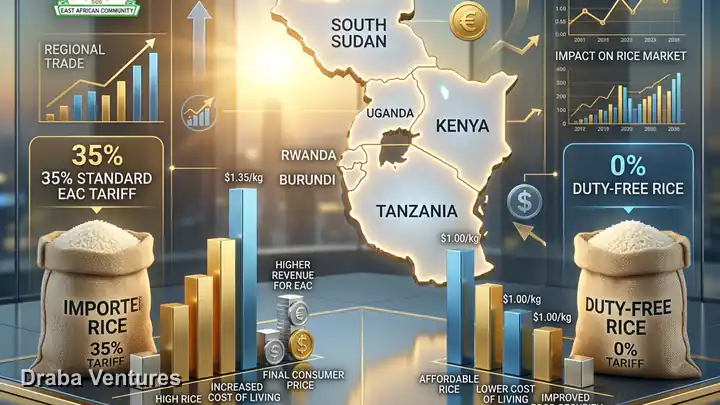
Under normal operational circumstances, rice imported into Kenya (and the broader EAC bloc) is subjected to a severe Common External Tariff (CET). Historically, this tariff ranges from 35% to as high as 75% depending on the specific harmonized system (HS) code classification and prevailing regional protectionist measures aimed at safeguarding domestic paddy farmers.
The gazetted waiver temporarily bypasses this tariff barrier, entirely zero-rating the import duty for a strictly defined volume. The quota is not indefinite; it is capped at exactly 490,000 MT and restricted exclusively to Grade 1 Milled White Rice. Inferior grades, parboiled rice, or high-broken percentages (such as standard 25% broken IR64) do not qualify for the exemption and will be taxed at the full CET rate upon customs declaration at Kilindini Harbour.
| Policy Parameter | Specification / Detail |
|---|---|
| Quota Volume | 490,000 Metric Tons (MT) |
| Commodity Specification | Grade 1 Milled White Rice (Strictly Non-Parboiled) |
| Tariff Waiver | Standard 35% - 75% EAC CET reduced to 0% (Duty-Free) |
| Primary Port of Entry | Kilindini Harbour, Port of Mombasa, Kenya |
| Compliance Standard | KEBS KS EAS 128:2013 (Grade 1 limits enforced) |
For Indian millers and global trading houses, monitoring real-time domestic Indian paddy price trends is critical. The viability of this export window relies heavily on locking in raw material procurement at the mill gate before domestic speculation drives FOB prices upward.
2. KEBS KS EAS 128:2013 Quality Standards (The Compliance Trap)
Why will standard 10% or 15% broken shipments fail at Mombasa customs?
The duty-free waiver is legally bound to the "Grade 1" classification under the KS EAS 128:2013 standard, which mandates a maximum of 5.0% broken grains. Any shipment exceeding this tolerance will be denied the waiver and slapped with the punitive 35%+ EAC tariff, obliterating trade margins.
The most critical point of failure in executing East African rice contracts is a misunderstanding of the Kenya Bureau of Standards (KEBS) East African Standard for Milled Rice (KS EAS 128:2013). This framework categorizes milled rice into Grade 1, Grade 2, and Grade 3.
Because the Kenyan National Treasury explicitly gazetted Grade 1 for the 490k MT exemption, the physical grain must undergo rigorous, high-intensity processing. This is where advanced Indian milling infrastructure—specifically Buhler Optical Color Sorting technology—becomes non-negotiable. Standard milling operations cannot reliably separate chalky and broken grains to the microscopic tolerances required by KEBS Grade 1 without sophisticated optical ejection systems.
| Quality Parameter (KS EAS 128:2013) | Maximum Allowed Limit for Grade 1 |
|---|---|
| Moisture Content | Max 13.0% |
| Broken Grains | Max 5.0% |
| Chalky Grains | Max 2.0% |
| Foreign Matter (Organic & Inorganic) | Max 0.1% |
| Discolored / Damaged Grains | Max 1.0% |
| Paddy Kernels | Max 0.2% (approx. 5 seeds per kg) |
| Milling Degree | Well-Milled, Double Sortex Cleaned |
At Draba Ventures, our integrated milling operations in the Tungabhadra basin utilize dual-pass optical sorting. This ensures that every 26kg PP bag or 50MT bulk container dispatched from our facilities comfortably clears the 5.0% broken limit and 2.0% chalky grain limit, neutralizing the risk of a KEBS compliance failure at Mombasa.
3. Port of Mombasa Logistics & PVoC Documentation Pipeline
What is the mandatory PVoC process for exporting rice to Kenya?
Pre-Export Verification of Conformity (PVoC) is a mandatory inspection process conducted at the country of origin (e.g., India) by approved agencies like SGS or Intertek. Failing to secure a Certificate of Conformity (CoC) before shipping results in a severe 15% CIF value penalty upon arrival at Mombasa.
Executing a CIF (Cost, Insurance, and Freight) Mombasa contract is a documentation-heavy endeavor. The maritime corridor from major Indian origin ports (such as Kakinada, Mundra, or Visakhapatnam) to Kilindini Harbour requires a synchronized pipeline of certificates to clear customs efficiently and claim the duty exemption.
Step-by-Step Documentation Protocol:
- Pre-Export Verification of Conformity (PVoC): Before the cargo leaves the Indian port, an authorized inspection agency (SGS, Intertek, or Bureau Veritas) must sample the rice, test it against the KS EAS 128:2013 Grade 1 standard, and issue a Certificate of Conformity (CoC). This is non-negotiable.
- Phytosanitary & Aflatoxin Certification: Plant Quarantine authorities in India must issue a phytosanitary certificate declaring the cargo free of pests (like the Khapra beetle) and conforming to strict aflatoxin limits.
- Bill of Lading (BL) Precision: The commercial invoice and the Bill of Lading must state precisely: "Grade 1 Milled White Rice". Vague descriptions like "Long Grain White Rice" may cause customs to challenge the duty-free application.
- Inland Logistics (SGR): Upon clearance at Mombasa, the majority of bulk rice is immediately transferred to the Standard Gauge Railway (SGR) network for rapid inland transit to the Nairobi Inland Container Depot (ICD Embakasi), bypassing truck congestion and securing the supply chain.
4. Comparative Freight Economics & CIF Mombasa Financial Matrix
How does the 35% tariff waiver impact the landed cost of rice in Kenya?
By removing the 35% EAC Common External Tariff, East African importers save approximately $145 to $170 per Metric Ton on the final landed CIF cost, fundamentally altering the wholesale margin economics and allowing aggressive retail pricing.
To understand the true magnitude of this gazetted window, one must break down the CIF (Cost, Insurance, and Freight) Mombasa financial architecture. The tariff is calculated on the total CIF value, not just the FOB cost.
Consider a hypothetical baseline matrix for Grade 1 Sona Masuri or RNR White Rice out of India (Note: Rates fluctuate daily, use our Cost Calculator for live FOB-to-CIF conversions):
- FOB Mill-Gate (India): ~$420.00 / MT
- Ocean Freight (India to Mombasa): ~$35.00 / MT
- Marine Insurance (Clause A): ~$2.00 / MT
- Total CIF Mombasa Value: ~$457.00 / MT
The Tariff Impact:
- Standard Scenario (35% CET): The importer pays 35% on the $457 CIF value. Duty paid = $159.95 / MT. Final landed cost before local port charges = $616.95 / MT.
- Duty-Free Gazetted Scenario: The importer pays 0% CET. Duty paid = $0.00 / MT. Final landed cost before local port charges = $457.00 / MT.
Margin Realization: The importer captures nearly $160/MT in absolute savings. On a standard 1,000 MT bulk contract, this translates to $160,000 in recovered capital, enabling massive competitive advantages in the East African wholesale markets.
At Draba Ventures, we engineer exact CIF Mombasa contracts for Grade 1 Non-Basmati White Rice, handling the entire PVoC compliance, optical sorting, and marine logistics pipeline.
Secure Your Duty-Free Kenya Quota Allocation
Leverage the 490,000 MT import window with guaranteed KEBS KS EAS 128 Grade 1 compliance. Contact Draba Ventures for live CIF Mombasa pricing and locked-in PVoC documentation.
Get Live Rates on WhatsApp Request a B2B Quote