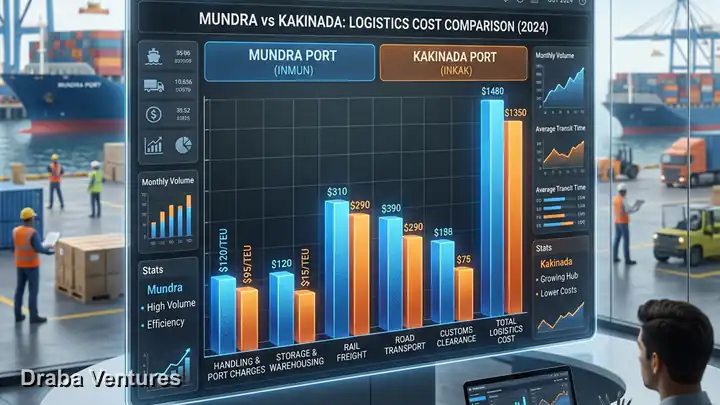
Kakinada Port remains the undisputed leader for large-scale break bulk rice exports to West Africa due to low inland freight from the Tungabhadra belt (₹1,800-₹2,200/MT) and specialized agricultural anchorage. However, for containerized shipments requiring rapid turnaround, lower minimum order quantities, and reliable liner schedules to destinations like Dakar or Cotonou, Mundra Port offers superior all-weather mechanization and connectivity, albeit with higher inland transport costs (₹4,500-₹5,500/MT).
The Strategic Importance of Port Selection in Rice Trading
For domestic aggregators, millers, and merchant exporters operating out of the Tungabhadra irrigation belt (spanning Sindhanur, Gangavati, Karatagi, and Raichur), port selection represents one of the most critical variables in overall export profitability. The West African market—encompassing major destination ports such as Cotonou (Benin), Dakar (Senegal), Abidjan (Ivory Coast), and Lomé (Togo)—is characterized by intense price sensitivity. In a market where FOB margins often hover in the low single digits, the logistical friction between the mill and the ship rail can dictate the commercial viability of a contract.
While the Indian subcontinent boasts a vast coastline dotted with major and minor ports, the export of non-basmati rice (particularly varieties heavily demanded in Africa like Parboiled, IR64, Swarna, and increasingly Sona Masuri and RNR for diasporic segments) is largely polarized between two massive nodes: Kakinada on the East Coast (Andhra Pradesh) and Mundra on the West Coast (Gujarat). Each port offers a radically different paradigm in terms of vessel handling, inland freight distance, custom clearance protocols, and ultimate landed cost.
This comprehensive technical analysis unpacks the infrastructure capabilities, cost differentials, and strategic decision matrices required by procurement heads and logistics managers when routing rice from the granary of Karnataka to the markets of West Africa. By optimizing this supply chain link, traders can significantly improve their competitive positioning in global tenders.
Sourcing Geography: The Tungabhadra Belt Advantage
The Tungabhadra irrigation command area in North Karnataka is arguably the most productive and consistent rice-growing region in South India. Towns like Sindhanur (often referred to as the "Rice Bowl of Karnataka"), Gangavati, and Karatagi host hundreds of modern, sortex-equipped mills capable of processing thousands of metric tons per week. The region produces premium Sona Masuri, Kaveri Sona, RNR (Samba Masuri), and Bullet varieties.
For merchant exporters based in Mumbai, Delhi, or Dubai, procuring directly from these mills represents a significant cost advantage over buying from secondary brokers. However, this advantage is only realized if the inland evacuation of the cargo is handled efficiently. The geographical placement of Sindhanur presents a fascinating logistical dichotomy:
- Distance to Kakinada Port: Approximately 580 to 620 kilometers. The route traverses from North Karnataka through Telangana and into coastal Andhra Pradesh. This is a traditional, well-established trucking corridor for agricultural commodities.
- Distance to Mundra Port: Approximately 1,550 to 1,650 kilometers. The route cuts through Maharashtra and deep into Gujarat. While the distance is nearly triple that of Kakinada, Mundra's container ecosystem draws massive volumes of cargo from across the country.
Understanding the interplay between these distances and the respective port handling capabilities is the crux of modern rice export logistics.
Kakinada Port: The Break Bulk Behemoth
Located in the Godavari delta on the eastern seaboard, Kakinada Port is intrinsically linked to India's agricultural export story. It operates primarily on an anchorage system combined with deep-water berths, specifically catering to the break bulk trade.
Infrastructure and Operational Dynamics
Kakinada's operational model for rice exports relies heavily on ship-to-shore lighterage operations. Large bulk carriers (often Handymax or Supramax vessels carrying 30,000 to 50,000 MT) anchor in the bay. Rice bags—typically 25kg or 50kg PP woven bags—are transported from the inland warehouses to the jetty, loaded onto barges, towed to the anchored vessel, and lifted into the ship's holds using the vessel's own cranes or floating cranes.
This method offers several advantages for massive volume traders:
- High Volume Aggregation: Exporters can charter entire vessels dedicated solely to rice, achieving massive economies of scale for large government tenders or major African importers.
- Specialized Labor: Kakinada possesses a vast, highly experienced labor force dedicated specifically to the manual handling, stacking, and slinging of rice bags. The speed at which barges are loaded is unparalleled in the region.
- Lower Port Dues: Break bulk operations generally incur lower terminal handling charges (THC) compared to container terminals, assuming demurrage can be avoided.
Limitations and Bottlenecks
The primary vulnerability of Kakinada's anchorage system is weather dependency. During the monsoon season (June to September), or during cyclonic depressions in the Bay of Bengal, barge operations frequently cease. Even a slight drizzle forces hatch covers to be closed to prevent moisture damage to the rice, leading to severe loading delays and potential vessel demurrage. Furthermore, break bulk requires a massive minimum order quantity (MOQ); it is not suitable for an exporter looking to ship just a few hundred tons.
Mundra Port: The Mechanized Container Hub
Mundra Port, operated by Adani Ports and Special Economic Zone (APSEZ) in the Gulf of Kutch, represents the zenith of mechanized, containerized cargo handling in India. While traditionally associated with industrial goods and North Indian basmati, its efficiency has increasingly drawn South Indian non-basmati rice destined for containerized African markets.
Infrastructure and Operational Dynamics
Mundra is an all-weather, deep-draft port capable of handling ultra-large container vessels (ULCVs). Rice exported through Mundra is typically stuffed into 20-foot equivalent units (TEUs) at inland container depots (ICDs) or at port-side container freight stations (CFSs).
The containerized route offers distinct strategic benefits:
- All-Weather Reliability: Mundra’s container operations are largely insulated from weather disruptions. Container gantry cranes operate year-round, and once the cargo is stuffed and sealed, it is protected from the elements.
- Lower MOQs and Flexibility: Exporters can ship as little as one container (approx. 24-26 MT of rice) at a time. This allows traders to serve smaller buyers in West Africa who cannot afford to charter a break bulk vessel.
- Rapid Transit via Liners: Major global shipping lines maintain regular weekly services from Mundra to transshipment hubs (like Salalah, Jebel Ali, or Colombo) connecting to West African ports, offering predictable transit times.
- Phyto-Sanitary and Fumigation: Mundra’s CFS ecosystem is highly organized for the mandatory methyl bromide or aluminum phosphide fumigation required for African destinations, ensuring strict compliance with importing country regulations.
Limitations and Bottlenecks
The glaring disadvantage for South Indian rice sourced from Sindhanur is the extreme inland freight distance. Transporting a metric ton of rice over 1,550 kilometers via truck to Gujarat adds a massive cost burden. Additionally, during global container shortages or freight rate spikes, the cost of ocean freight per TEU can erode the margins entirely.
Cost Differentials: Analyzing the Inland Freight Economics
To accurately compare the two ports, a domestic aggregator must calculate the FOB (Free on Board) cost, which includes the mill-gate price plus inland freight, handling, and customs clearance. Let us examine the inland logistics component in detail.
Trucking from Sindhanur involves heavy-duty multi-axle vehicles (typically 10-wheelers carrying 16-20 MT, or 14-wheelers carrying 25-30 MT). The freight rates are dictated by diesel prices, return load availability, and seasonal demand.
- Sindhanur to Kakinada: Given the ~580 km distance, transit time is usually 24 to 36 hours. The trucking route is well-serviced, with trucks often finding return loads of fertilizer or industrial goods from the coast. Freight rates generally fluctuate between ₹1,800 to ₹2,200 per Metric Ton.
- Sindhanur to Mundra: The ~1,550 km journey requires 4 to 6 days of transit time. The route crosses multiple state borders (Karnataka, Maharashtra, Gujarat). Finding a direct truck is challenging, and return loads are less guaranteed, forcing the outward journey to absorb more of the round-trip cost. Freight rates range steeply from ₹4,500 to ₹5,500 per Metric Ton.
This creates an immediate inland freight disadvantage of approximately ₹2,700 to ₹3,300 per MT for Mundra. For a commodity where international traders fight over variations of $5 to $10 per MT, this ₹3,300 ($40 USD) difference is colossal. Therefore, exporting via Mundra is only viable if the ocean freight (container vs break bulk) or the buyer's premium offsets this inland penalty.
| Rice Variety | Mill Gate Price (per Qtl) | Mill Gate Price (per 26kg) | Mill Gate Price (per MT) | Inland Freight to Kakinada (/MT) | Inland Freight to Mundra (/MT) |
|---|---|---|---|---|---|
| Sona Masuri (HMT) | ₹3,400 | ₹884 | ₹34,000 | ₹2,000 | ₹5,000 |
| Kaveri Sona | ₹3,600 | ₹936 | ₹36,000 | ₹2,000 | ₹5,000 |
| RNR (Samba Masuri) | ₹3,200 | ₹832 | ₹32,000 | ₹2,000 | ₹5,000 |
| Bullet Rice | ₹3,000 | ₹780 | ₹30,000 | ₹2,000 | ₹5,000 |
*Indicative prices for baseline comparison. Freight rates vary based on fuel prices and truck availability.
🇮🇳 Direct-to-Mill Domestic Supply Desk
Sourcing for Indian distribution networks, supermarkets, or HORECA chains? Skip urban broker layers. Track live mandi rates on our Market Intelligence Tracker, simulate freight values via our Cost Calculator, or tap the WhatsApp widget for immediate mill-gate pricing quotes.
Quality Preservation During Transit
When rice leaves the climate-controlled environment of a sortex mill in Sindhanur, it begins a perilous journey. The preservation of grain quality—specifically managing moisture content, preventing insect infestation, and avoiding grain breakage—is paramount.
For shipments routed to Kakinada, the shorter transit time (1-2 days) minimizes the risk of exposure to sudden temperature fluctuations. However, once at the port, the rice is often stored in godowns before being loaded onto barges. If humidity levels are high, the rice can absorb moisture. To combat this, professional exporters utilize high-density polyethylene (HDPE) lined bags and ensure rapid loading cycles.
Conversely, the journey to Mundra involves nearly a week of road transit. Trucks traveling from the moderate climate of Karnataka through the intense heat of Maharashtra and into the coastal humidity of Gujarat subject the cargo to thermal cycling. This can lead to "container sweat" or condensation inside the truck tarpaulins. To mitigate this, exporters shipping via Mundra often mandate the use of silica gel desiccant packs within the containers during stuffing, absorbing excess moisture during the long ocean voyage to West Africa.
Fumigation is critical for both routes. African agricultural authorities are stringent regarding live insect presence. Whether the cargo is break bulk in Kakinada or containerized in Mundra, it must undergo certified fumigation (typically Aluminum Phosphide for rice) and be issued a Phyto-Sanitary Certificate by the Directorate of Plant Protection, Quarantine & Storage (DPPQS) prior to departure.
Ocean Freight Dynamics to West Africa
The final leg of the logistical equation is the ocean voyage. West Africa's primary receiving ports—Cotonou (a major transit hub for neighboring landlocked countries like Niger), Dakar, and Abidjan—have varying capabilities for receiving break bulk versus containerized cargo.
The Kakinada Break Bulk Route: Chartering a vessel from Kakinada to West Africa involves negotiating voyage charter rates. These rates fluctuate based on the Baltic Dry Index and global vessel positioning. A typical voyage to Cotonou takes roughly 25 to 35 days depending on the vessel's speed and route (e.g., via the Cape of Good Hope). The advantage here is the sheer volume deposited at once, allowing African wholesalers to flood the local market and dominate pricing.
The Mundra Container Route: Container shipping operates on fixed liner schedules. Major carriers like Maersk, MSC, and CMA CGM offer services from Mundra to West Africa. These routes often involve transshipment—the cargo is unloaded at a hub in the Middle East or Europe and reloaded onto a different vessel heading south to Africa. While this can extend transit times to 35-45 days, it provides incredible consistency. Furthermore, container freight rates, while historically volatile (especially post-pandemic), offer transparency and predictability for smaller contracts.
Decision Matrix: Kakinada vs Mundra
How does a merchant exporter or domestic aggregator decide? The choice ultimately boils down to a calculus of volume, capital constraints, buyer preference, and seasonality. To simplify this complex decision-making process, we have developed a strategic decision matrix.
| Strategic Factor | Kakinada Port (East Coast) | Mundra Port (West Coast) |
|---|---|---|
| Primary Shipping Mode | Break Bulk (Vessel Charter) | Containerized (FCL) |
| Inland Freight from Sindhanur | Low (₹1,800 - ₹2,200/MT) | High (₹4,500 - ₹5,500/MT) |
| Minimum Order Quantity (MOQ) | Extremely High (10,000+ MT typically) | Low (24-26 MT / 1 TEU) |
| Weather Resilience | Poor (Vulnerable to Monsoon/Cyclones) | Excellent (All-weather mechanized) |
| Best Suited For | Massive government tenders, large African wholesalers looking to minimize landed cost. | Private label brands, smaller African distributors, shipments requiring strict moisture control. |
| Turnaround Time at Port | Variable (Dependent on barge availability and weather) | Highly predictable (Liner schedules) |
For traders aggregating Sona Masuri or RNR from Draba Ventures in Sindhanur, the general heuristic is clear: If the contract is for thousands of metric tons destined for a bulk importer in Benin or Senegal, the inland freight savings of routing through Kakinada overwhelm any other factor. The trader must simply manage the weather risks and charter effectively.
However, if the trader is shipping 10 to 50 containers of premium, sortex-cleaned, double-bagged rice to a specialized buyer in Ivory Coast who demands precise delivery windows and zero handling damage, the containerized route via Mundra—despite the steep inland trucking cost—provides the necessary operational control and quality assurance.
Financial Mechanics: FOB vs. CIF Pricing Models
When domestic aggregators quote to West African buyers, the pricing model is fundamentally shaped by the chosen port. The two most common Incoterms in this trade are FOB (Free On Board) and CIF (Cost, Insurance, and Freight). Understanding how port selection impacts these models is critical for protecting profit margins.
In a FOB Kakinada contract, the Indian exporter's liability ends once the rice is loaded onto the break bulk vessel. The African buyer bears the ocean freight cost and the risk of voyage delays. Because Kakinada operates on massive economies of scale for break bulk, the FOB price here is often highly competitive. However, the exporter must still absorb the inland freight from Sindhanur, local port handling, and custom clearance charges before the cargo crosses the ship's rail. If unseasonal rains halt barge operations, the resulting demurrage charges must be negotiated carefully, often requiring specific clauses in the LC (Letter of Credit).
Conversely, in a CIF Cotonou (via Mundra) contract, the Indian exporter is responsible for securing the container freight all the way to Benin. Mundra's vast network of liner services allows exporters to lock in container freight rates months in advance. This predictability enables precise CIF quoting. Furthermore, containerized shipping allows the exporter to offer smaller, more frequent shipments (e.g., 5 containers per week) rather than a single massive break bulk delivery. This aligns perfectly with the cash-flow cycles of mid-tier African distributors who cannot tie up millions of dollars in a single letter of credit.
The Role of Customs House Agents (CHAs) and Documentation
Port selection is not just about physical infrastructure; it is equally about administrative efficiency. The speed at which a Customs House Agent (CHA) can process paperwork directly impacts the turnaround time of the cargo.
At Kakinada, the CHA ecosystem is deeply specialized in bulk agricultural commodities. The local customs officials are highly familiar with rice export protocols, Phytosanitary certification, and the specific requirements of major African importing nations. Documentation for a 20,000 MT shipment is often streamlined due to decades of established precedent. However, because multiple exporters might be consolidating cargo onto a single vessel, meticulous tallying and mate's receipt management are required to avoid disputes over loaded quantities.
At Mundra, the environment is fundamentally different. It is a multi-commodity, highly digitalized hub. CHAs operate through advanced EDI (Electronic Data Interchange) systems. Once a container is stuffed at the CFS (Container Freight Station), sealed, and fumigated, the Let Export Order (LEO) is often generated with minimal human intervention. For exporters prioritizing speed and transparency, Mundra's digital-first customs environment offers a significant advantage, reducing the "invisible" costs associated with administrative delays.
Deep Dive: Bagging Strategies for Export
The packaging format is intrinsically linked to port handling capabilities. While the domestic South Indian market operates almost exclusively on the 26kg PP woven bag (as detailed in our other B2B guides), the export market to West Africa demands different specifications.
For break bulk shipments via Kakinada, the standard is the 50kg PP bag. These bags must be manufactured with a higher GSM (Grams per Square Meter) to withstand the immense pressure of being stacked in the deep holds of a bulk carrier. The slings used to lift the bags from the barge to the vessel exert tremendous point-loading stress on the bag fabric. A burst bag in the hold not only causes product loss but slows down the entire unloading process in Africa.
For containerized shipments via Mundra, exporters have more flexibility. While 50kg is still common, there is a growing demand for 25kg or even 26kg bags tailored for specific retail markets in Senegal or Ivory Coast. Because the bags are stuffed manually or via conveyor directly into the container and are not subjected to crane slinging, exporters can sometimes optimize the bag GSM slightly, though this must be balanced against the risk of condensation damage.
Conclusion: Mastering the Supply Chain
Exporting rice is not merely about procuring the right grain; it is an exercise in mastering multidimensional logistics. The Tungabhadra belt produces some of the finest non-basmati rice in the world, perfectly suited for the caloric and culinary demands of West Africa. Whether an exporter chooses the massive, cost-effective break bulk operations of Kakinada or the precise, containerized reliability of Mundra, success depends on meticulous calculation of inland freight, port handling charges, and ocean transit variables.
By partnering with established, mill-direct suppliers like Draba Ventures, merchant exporters can secure the high-quality base commodity at optimal mill-gate prices, allowing them the financial flexibility to construct a robust, profitable logistics corridor to the African continent.
