For international roasting houses and green coffee importers, maritime logistics bottlenecks and customs delays represent severe balance-sheet liabilities. A single discrepancy in an ocean bill of lading, a missing phytosanitary seal, or an unexpected customs quarantine hold can trigger crippling port demurrage charges running into thousands of dollars per container. Executing frictionless green coffee import customs clearance India requires legal precision under International Chamber of Commerce (ICC) Incoterms 2020 and rigorous quality control at origin. Draba Ventures structures transparent, audit-ready supply chains from New Mangalore Port (NMPA) to destination terminals worldwide, guaranteeing seamless clearance, statutory compliance, and zero demurrage exposure.
Incoterms 2020 and Liability Transfer
In international commodity trade, contractual clarity is the foundation of profitability. The International Chamber of Commerce (ICC) Incoterms 2020 define the exact division of responsibilities, operational costs, and risk transfer between the seller and buyer. For green coffee shipments from India, Draba Ventures structures trade predominantly under two standardized maritime rules: Free on Board (FOB) and Cost, Insurance, and Freight (CIF).
Understanding the precise moment of risk and liability transfer is essential for procurement managers:
- FOB (Free on Board - Port of New Mangalore, India): Under FOB terms, Draba Ventures assumes full financial and operational responsibility for curing, grading, statutory export licensing, inland transport from Karnataka's Western Ghats, port handling, and customs clearance at New Mangalore Port (NMPA). Risk officially transfers to the importing buyer the exact second the cargo passes the ship's rail and is securely stowed on board the ocean vessel. The buyer contracts ocean carriage, nominates the shipping line, and manages destination clearance.
- CIF (Cost, Insurance, and Freight - Destination Port): Under CIF terms, Draba Ventures arranges and prepays the ocean freight to the buyer's designated port of entry (such as Hamburg, Antwerp, Rotterdam, Trieste, Genoa, Le Havre, or Long Beach). Furthermore, Draba Ventures secures marine cargo insurance covering 110% of contract value under Institute Cargo Clauses (A) (All Risks). However, critical to Incoterms 2020 rules, the transfer of physical transit risk occurs at origin when the cargo is loaded on board the vessel, while financial responsibility for freight and insurance remains with the seller until the destination port.
| Commercial Parameter | FOB (Free on Board - NMPA) | CIF (Cost, Insurance & Freight) | Operational Roaster Impact |
|---|---|---|---|
| Origin Export Clearance | Handled & paid by Draba Ventures | Handled & paid by Draba Ventures | Zero regulatory friction at Indian port |
| Point of Risk Transfer | When goods are loaded on board vessel | When goods are loaded on board vessel | Defines insurance claim responsibility |
| Ocean Freight Contract | Booked & paid by Buyer | Booked & prepaid by Draba Ventures | CIF eliminates freight rate volatility for roasters |
| Marine Insurance Policy | Procured by Buyer | Procured by Draba (Institute Clauses A - 110%) | Guaranteed comprehensive All-Risk coverage |
| Destination Port Handling | Managed & paid by Buyer | Managed & paid by Buyer | Buyer customs broker clears terminal cargo |
Origin Documentation and Zero Demurrage
Port storage fees and shipping line equipment retention penalties (demurrage and detention) represent one of the largest hidden drains on commercial roaster margins. At major European and North American ports, demurrage fees range between $150 and $350 per container per day after the standard free-time window expires. The primary catalyst for demurrage is paper-trail error: mismatched HS codes, inaccurate weight declarations, or late presentation of statutory original documents.
Draba Ventures implements a zero-demurrage protocol backed by digital pre-clearance and multi-tier statutory verification:
- Commercial Invoice & Packing List: Itemized documentation detailing exact gross/net weights, container numbers, seal numbers, lot numbers, and agreed Incoterms 2020 clauses.
- Clean On Board Ocean Bill of Lading (OBL): Issued by top-tier shipping lines (such as Maersk, MSC, or Hapag-Lloyd) confirming receipt of sound cargo with zero clauses, available as original negotiable sets or electronic sea waybills for rapid surrender.
- Statutory ICO Certificate of Origin: Issued under the International Coffee Agreement through the statutory Coffee Board of India, validating geographical provenance, botanical species (Coffea Arabica or Coffea Canephora/Robusta), and export grade.
- Official Phytosanitary Certificate: Granted by the Directorate of Plant Protection, Quarantine & Storage, Ministry of Agriculture of India, certifying that the lot is thoroughly inspected, fumigated with statutory treatments if required, and 100% free from quarantine pests.
- Digital Pre-Arrival Filing: Complete document packages are transmitted electronically to the buyer's customs clearing agent 7 to 10 days prior to ocean vessel berthing, enabling pre-arrival customs entry filings and instant container release.
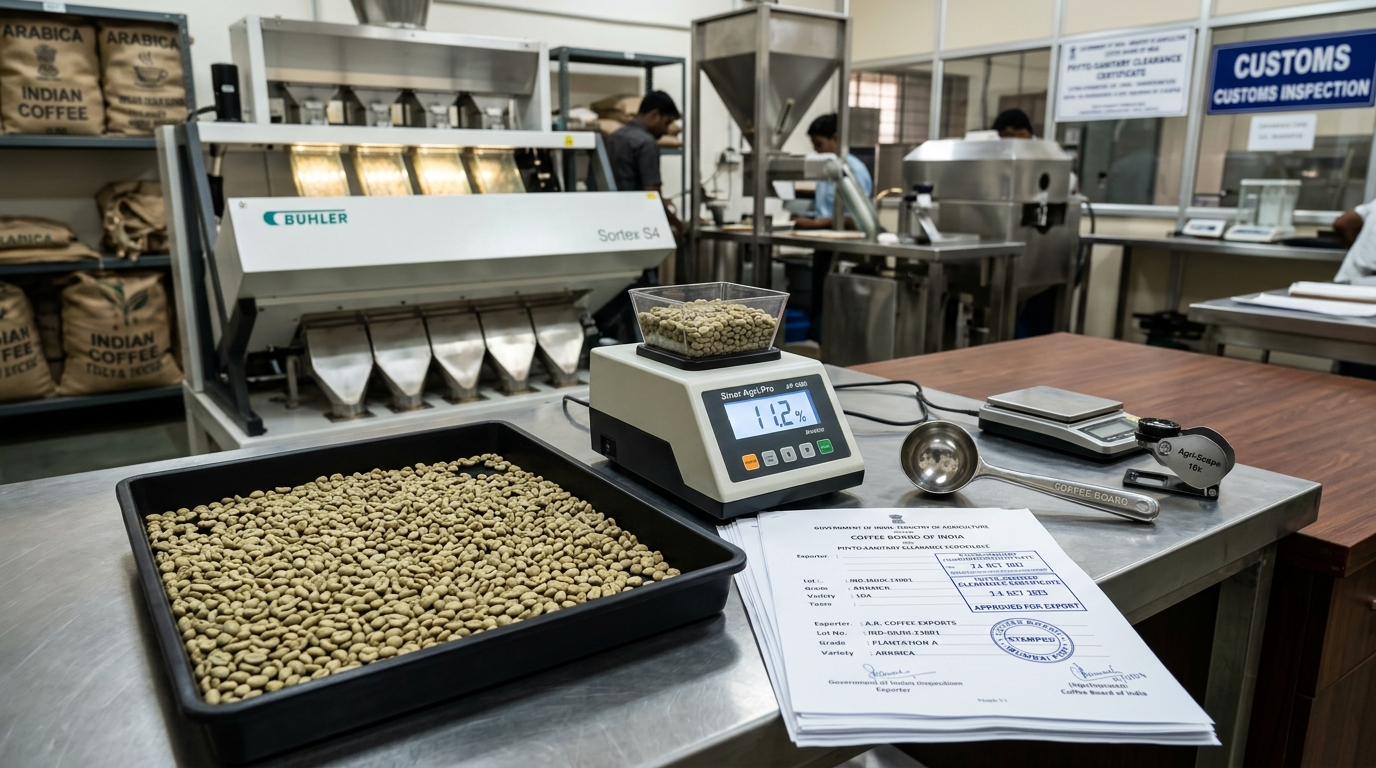
Figure 1: Statutory compliance and physical verification. Screen 18 green coffee beans with digital moisture verification (11.2%) and official phytosanitary export seals.
Quality Assurance and Optical Defect Extraction
Destination border agencies (such as US CBP/FDA, EU Border Control Posts, and national customs administrations) conduct random physical inspections and laboratory sampling. If a container exhibits extraneous plant debris, animal matter, or insect infestation, border authorities issue immediate quarantine holds, re-export orders, or mandated fumigations that can destroy green coffee cup quality and inflate costs.
Draba Ventures eliminates border inspection rejections through industrial optical Sortex processing:
- Hyperspectral VIS/NIR Sortex Technology: Raw coffee lots pass through high-precision optical sorters operating at 94.63% sorting accuracy. High-speed multi-spectrum cameras inspect each bean in both visible and near-infrared bandwidths.
- Extraction of Contaminants and Damaged Seeds: Pneumatic air jets instantly eject insect-damaged beans, hollow seeds, husks, stones, and glass fragments that could trigger phytosanitary flags during physical cargo probing.
- Uniform Screen Calibration: Lots are sorted to rigid dimensional tolerances: Screen 18+ for Plantation AA and Cherry AA, and Screen 15/16 for AB grades. Physical uniformity ensures smooth sampling audits by destination port botanists.
- Auditable Quality Certificates: Every exported lot is accompanied by a certified pre-shipment inspection report documenting screen distribution, moisture percentage, bean count per 100g, and verified defect tolerances.
Moisture Control and Maritime Security
Maritime transit across equatorial waters exposes containerized green coffee to intense thermal and hygrometric shocks. As vessels transition between tropical climates and temperate destination ports, moisture within unlined jute bags evaporates and condenses against cold steel container walls (container sweat). This condensation creates microclimates where xerophilic mold strains, particularly Aspergillus ochraceus, synthesize Ochratoxin A (OTA).
Under European Commission Regulation (EU) 2023/915 and global food safety mandates, green coffee exceeding 3.0 ppb of OTA is legally prohibited from entering food processing streams, leading to mandatory customs seizure and cargo incineration.
Draba Ventures neutralizes maritime contamination through an airtight preservation architecture:
- Terminal Moisture Stabilized (<12.0%): Prior to bagging, raw beans are kiln-dried and conditioned to strictly between 10.5% and 11.5% moisture, locking water activity (aw) below 0.58. This suppresses all fungal spore activation.
- Hermetic GrainPro Liners: Lots are packed in standard 60kg export jute sacks fitted with multi-layer hermetic GrainPro liners. These gastight, moisture-barrier polymer liners isolate the beans from high ambient maritime humidity and ocean salt spray.
- Zero OTA Formulation Guarantee: Intact hermetic liners keep internal relative humidity below 65%, preventing OTA formation throughout 30 to 60 days of ocean navigation and destination warehouse storage.
- Engineered Containerization: Standard 20ft FCLs (300 bags x 60kg, 18.0 MT) stuffed at New Mangalore Port (NMPA) are equipped with heavy-duty calcium chloride desiccant poles and insulating kraft paper ceilings to absorb any residual air moisture.
