When loading port certificates (e.g., 5% brokens) conflict with destination re-testing (e.g., 8% brokens), resolution hinges entirely on whether the contract stipulated "Final at Loading" or "Retest Rights." Buyers and sellers must utilize GAFTA standard terms and execute Joint Sampling Protocols to legally binding independent appeal laboratories to resolve high-stakes quality variance disputes.
The "Final at Loading" Clause
The cornerstone of agricultural commodity export is the Third-Party Inspection Certificate (issued by SGS, Intertek, Bureau Veritas, or Geo-Chem). Under standard GAFTA (Grain and Feed Trade Association) rules, most FOB and CIF contracts are designated as "Quality and Weight Final at Loading Port."
This means that once the surveyor stamps the cargo as 5% broken and 12% moisture in India, the seller has fulfilled their obligation. (Learn more about our domestic sourcing standards on our Market Intelligence Hub).
The Conflict: Destination Retesting
Disputes ignite when the buyer hires a different surveyor at the destination port, and the new results show 8% brokens and 14% moisture. Under "Final at Loading," the buyer has no legal recourse for degradation that occurred during transit. However, if the variance is massive, buyers will claim the initial certificate was fraudulent or negligently issued.
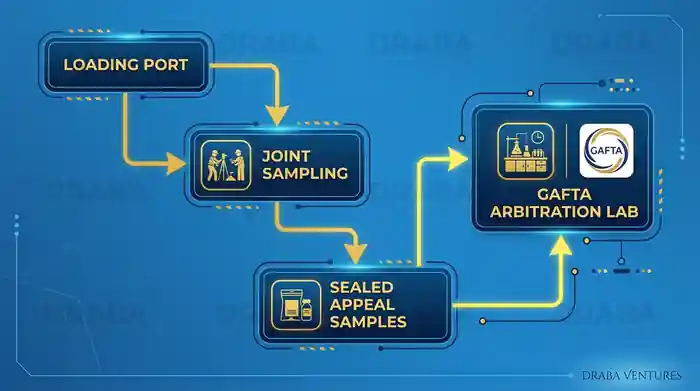
Operational Blueprint for Dispute Resolution
Step 1: The Joint Sampling Protocol
If the cargo is rejected at destination, the buyer must immediately notify the seller. A Joint Sampling must be arranged where representatives from both the buyer’s surveyor and the seller’s surveyor draw samples simultaneously from the container.
Step 2: Sealed Appeal Samples
During the loading process, the initial surveyor always retains sealed "Appeal Samples." These are kept in climate-controlled storage for 3 to 6 months specifically for arbitration.
Step 3: GAFTA Arbitration Lab
If the Joint Sample fails to resolve the issue, the sealed Appeal Sample is sent to a neutral, GAFTA-accredited independent laboratory. The results of this third laboratory are considered legally binding and absolute.
Draba Ventures Policy
We mandate dual-sampling for all bulk shipments. We retain physical, sealed samples signed by SGS at our headquarters, ensuring total transparency and immediate resolution in the rare event of a quality dispute.