In the hyper-competitive global specialty coffee landscape, commercial differentiation hinges on sensory exclusivity. Discerning specialty roasters and boutique coffee brands can no longer rely solely on conventional washed and standard dry-processed offerings to captivate retail consumers and subscription members. The Western Ghats of Karnataka-renowned for its biodiversity-rich, high-altitude shade-grown estates-has rapidly evolved into an avant-garde hub for precision biochemical processing. Sourcing experimental fermentation green coffee India directly through Draba Ventures unlocks small-batch, competition-grade micro-lots that combine exotic fruit-forward cup profiles with uncompromising physical purity and complete estate traceability.
Sourcing Micro-Lots and Experimental Fermentation
The traditional categorization of Indian green coffees into standard Plantation (washed Arabica) and Cherry (natural Robusta and Arabica) is being fundamentally reshaped by scientific processing. Specialty producers across Chikmagalur, Coorg, and the Bababudangiri hills are leveraging advanced post-harvest biotechnology to curate targeted biochemical transformations within the coffee cherry:
- Anaerobic Fermentation (Naturals & Washed): Freshly harvested, high-Brix ripe cherries are sealed into food-grade, airtight stainless steel or heavy-polyethylene bio-reactors equipped with one-way valves. By depriving the cherry mass of atmospheric oxygen, indigenous lactic acid bacteria (LAB) and selected yeasts dominate the metabolic pathway. This produces heightened levels of lactic and malic acids, yielding intense sensory notes of passionfruit, ripe blackberry, candied ginger, and velvety dark chocolate.
- Carbonic Maceration (CM): Borrowed from elite viticulture, carbonic maceration involves injecting carbon dioxide (CO2) into sealed fermentation tanks to establish a hyper-saturated, pressurized inert environment. This anaerobic pressure forces intracellular fermentation inside the unpulped cherry skin, softening sharp tannins and producing exceptionally clean, winey, floral, and sparkling stone-fruit flavour complexities.
- Yeast-Inoculated Fermentation: Estate managers introduce isolated wine and brewing yeast strains (such as Saccharomyces cerevisiae and Pichia kluyveri) at calibrated ambient temperatures, accelerating the synthesis of fruit esters and guaranteeing repeatable cupping score profiles across successive harvest batches.
| Experimental Method | Oxygen Environment | Primary Acid / Ester Formation | Sensory Cup Profile | SCA Cup Score Potential |
|---|---|---|---|---|
| Anaerobic Natural | Sealed bio-reactors (Zero O2, 72-120 hrs) | Lactic acid & ethyl butyrate esters | Ripe tropical fruit, rum, wild berry, molasses | 86.5 - 88.5 SCA |
| Carbonic Maceration | Pressurized CO2 injection (Zero O2, 48-96 hrs) | Malic acid & volatile fruity ketones | Bright stone fruit, sparkling acidity, floral tea, red wine | 87.0 - 89.0 SCA |
| Yeast-Inoculated Washed | Controlled wet-tank inoculation | Isoamyl acetate & targeted organic esters | Crisp green apple, jasmine blossom, delicate citrus clarity | 86.0 - 87.5 SCA |
The Economics of Specialty Micro-Lots
While commercial green coffee procurement focuses on containerized volume economics (FCLs) and exchange differentials, specialty micro-lot sourcing operates on scarcity, brand elevation, and retail pricing power. Micro-lots typically represent isolated harvest blocks yielding between 5 and 50 bags (300kg to 3,000kg) of exceptional coffee:
- Brand Halo and Portfolio Differentiation: Offering an exotic anaerobic Indian micro-lot on a roastery menu captures the attention of third-wave wholesale accounts and specialty coffee media. It validates the roaster's procurement pedigree, driving halo sales across standard commercial blend offerings.
- Retail Margin Expansion: Commercial blends often yield gross roasting margins of 25% to 35%. In contrast, specialized micro-lot releases, packaged in 250g retail bags or luxury subscription drops, frequently command retail prices exceeding $22 to $30 per bag, unlocking gross roaster margins of 55% to 70%.
- Barista and Brewer Championship Placement: The explosive aromatic intensity and unique floral-fruit complexity of Indian experimental micro-lots provide competition baristas with a distinctive sensory narrative that scores exceptionally well on World Coffee Events (WCE) sensory evaluation scorecards.
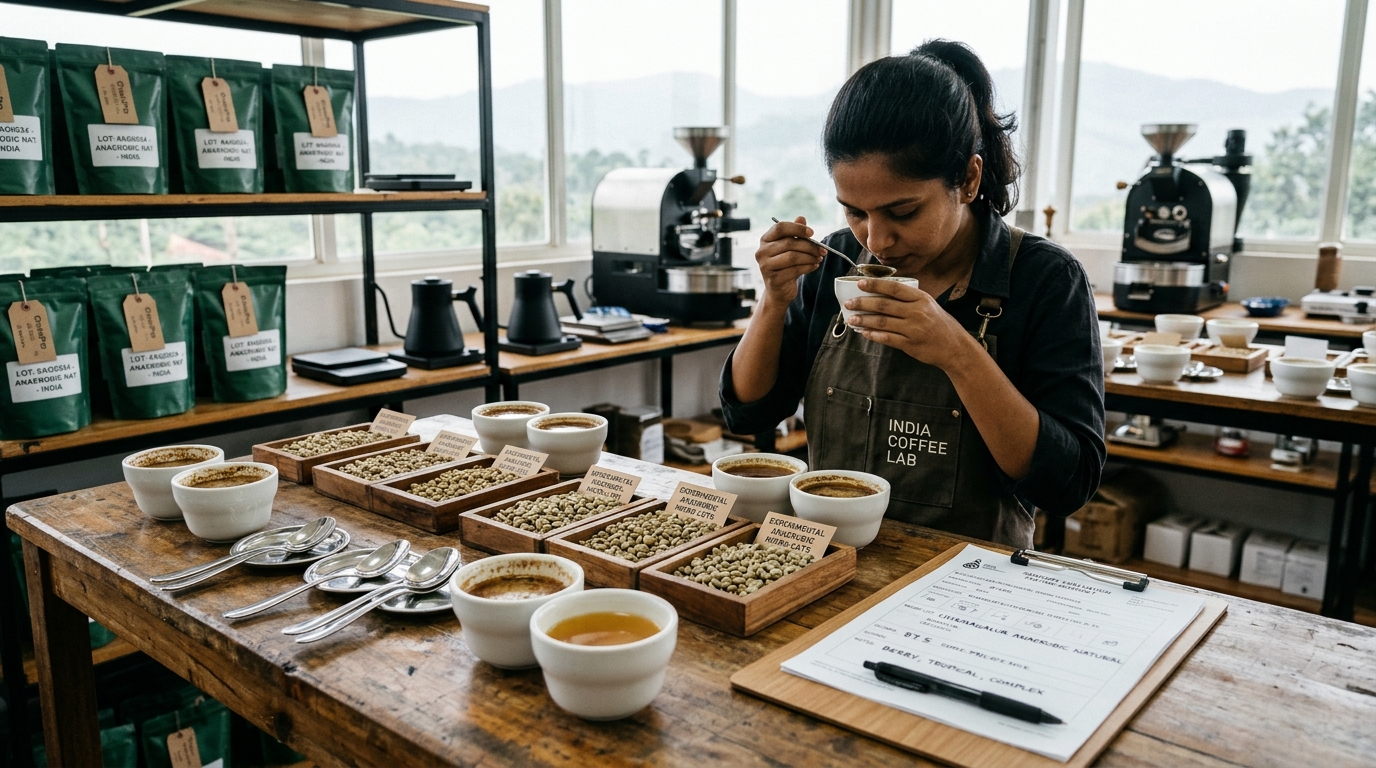
Figure 1: Sensory quality assurance. Certified Q-grader laboratory cupping and optical Sortex defect verification for experimental anaerobic micro-lots from Karnataka, India.
Quality Assurance and Optical Defect Extraction
Extended fermentation protocols carry inherent physical risks. Without scientific oversight, extended anaerobic maceration can quickly descend into uncontrolled over-fermentation, producing butyric acid defects (rotting onion or cheese notes), partial black beans, and internal structural degradation that devastates cupping scores.
Draba Ventures establishes rigorous physical safeguards to eliminate over-fermentation risk:
- VIS/NIR Hyperspectral Sortex Grading: Milled micro-lots undergo multi-stage optical color sorting operating at 94.63% defect extraction accuracy. Hyperspectral camera arrays identify subtle pigmentary shifts, ejecting over-fermented sour beans, hollow seeds, and insect-damaged kernels that human sorters miss.
- Density Separation and Screen Sizing: Micro-lots are processed through precision gravity separator tables and perforated screen classifiers (Screen 18+ for specialty Arabica selections) to ensure uniform kernel density for flawless thermal heat transfer in the roaster drum.
- Dual-Stage Sensory Calibration: Every individual micro-lot batch is cupped at origin by licensed Q-graders using SCA protocols to evaluate fragrance, aroma, flavor, acidity, body, and overall cup harmony. Batches exhibiting any phenolic, chemical, or acetic taints are strictly disqualified.
Moisture Control and Maritime Security
Due to the concentration of hygroscopic sugars and organic acids accumulated during prolonged mucilage contact, experimentally fermented green coffees are exceptionally vulnerable to moisture re-absorption and mold growth during intercontinental sea freight. Ambient humidity spikes inside container holds can rapidly trigger Ochratoxin A (OTA) contamination.
Draba Ventures implements specialized transport preservation for all specialty micro-lot exports:
- Calibrated Moisture Boundary (<12.0%): Prior to bagging, micro-lots undergo slow, shade-covered patio or raised African bed drying, stabilizing internal seed moisture strictly between 10.5% and 11.2% with a water activity (aw) level below 0.58.
- GrainPro Hermetic Barrier Liners: Micro-lots are hermetically heat-sealed or cable-tied in multi-layer GrainPro liners inside sturdy 30kg or 60kg export bags. This oxygen-deprived barrier halts fungal spore multiplication, protects delicate enzymatic aromatics, and completely blocks external humidity ingress.
- Consolidated LCL and Air-Freight Options: For elite boutique roasters requiring immediate seasonal releases, Draba Ventures coordinates temperature-controlled Less-than-Container-Load (LCL) consolidated shipments and express air freight to Europe, the UK, the Middle East, and North America.
Frequently Asked Questions
What makes Indian experimental fermentation green coffee unique for specialty roasters?
India's high-altitude shade-grown estates in the Western Ghats (Chikmagalur and Coorg) combine rich volcanic soil, diverse microclimates, and indigenous forest canopy with precision anaerobic and carbonic maceration methods. This yields complex, fruit-forward, winey, and tropical flavor profiles that score 86 to 88+ on the SCA scale.
How does Draba Ventures prevent over-fermentation defects in specialty micro-lots?
Draba Ventures pairs strict processing parameters (Brix tracking, pH monitoring, and temperature control) with VIS/NIR Hyperspectral Sortex optical sorting at 94.63% accuracy. This removes sour beans, partial blacks, and insect-damaged seeds, ensuring a clean and defect-free cup.
What is the typical minimum order quantity (MOQ) for experimental micro-lots?
Unlike commercial green coffee requiring a full 20ft container (19.2 metric tons), specialty micro-lots can be procured in boutique volumes ranging from 5 to 50 bags (300kg to 3,000kg), shipped via consolidated LCL sea freight or expedited air freight.
How are delicate enzymatic flavor profiles preserved during ocean shipping?
Every micro-lot is dried to a water activity below 0.58 and moisture below 12.0%, then sealed inside multi-layer GrainPro hermetic liners. This barrier isolates the beans from external humidity and ocean moisture, preventing OTA mold and preserving fresh-crop aroma.
Can roasters request custom fermentation profiles with Draba Ventures?
Yes. Draba Ventures partners with leading estates in Chikmagalur and Coorg to execute custom processing contracts, including specific anaerobic durations, yeast strain inoculations, and tailored honey/natural drying protocols for dedicated roastery clients.
