In high-volume agricultural commodity trading, managing counterparty risk is paramount. Whether you are shipping a 12-MT truckload of Sona Masuri from Sindhanur, Karnataka, to a bulk distributor in Gujarat, or exporting a 20-foot container of RNR Samba Masuri to Dubai, transferring ownership of the cargo requires airtight financial mechanisms. The sheer volatility in grain pricing—often swinging by ₹100 to ₹300 per quintal within a single harvest month—amplifies the risk of buyers backing out or delaying payments.
When parties do not wish to use the rigidity of a Letter of Credit (LC) or the high buyer-risk of 100% advance payments, they turn to Documentary Collections. In international trade (and sophisticated domestic inter-state trade), this mechanism is governed by two primary payment terms: Documents Against Payment (D/P) and Documents Against Acceptance (D/A).
Under Documents Against Payment (DP), the buyer must pay the full invoice amount to their bank before the bank releases the Lorry Receipt (LR) or Bill of Lading (B/L) required to take delivery. Under Documents Against Acceptance (DA), the buyer merely signs (accepts) a Bill of Exchange committing to pay at a future date (e.g., 30 days) to receive the documents. DP prioritizes supplier cash flow and cargo security, while DA acts as a credit facility that carries higher default risk for the seller.
Understanding Documentary Collections in Bulk Rice Trade
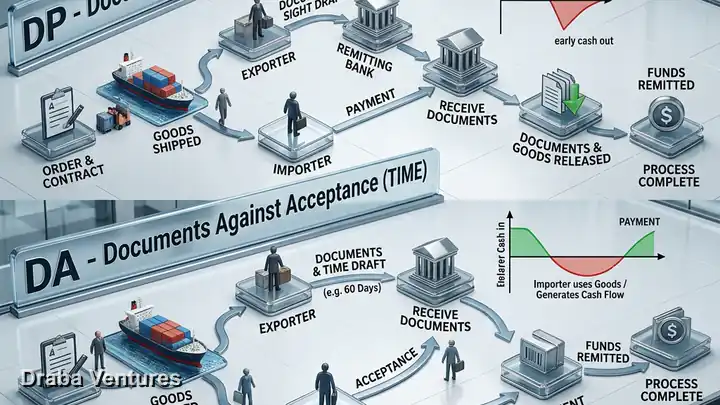
A documentary collection is a trade finance mechanism where the supplier (exporter or domestic miller) entrusts the handling of commercial and transport documents to their bank (the remitting bank). The remitting bank forwards these documents to the buyer’s bank (the collecting bank) with specific instructions on how and when to release them to the buyer.
The system leverages a fundamental truth in logistics: the buyer cannot clear the goods from the transporter (or port customs) without the original transport document. In domestic trade, this is the Lorry Receipt (LR). In export trade, it is the Bill of Lading (B/L).
By routing the LR through the banking channel rather than mailing it directly to the buyer, the supplier uses the collecting bank as a secure intermediary. The bank will only hand over the LR if the buyer fulfills the condition—either immediate payment (DP) or promising future payment by signing a legal instrument (DA).
🇮🇳 Domestic Application: The "Hundi" System
While DP/DA is famous in international trade under the URC 522 rules, the exact same principle applies in domestic Indian trade via trade bills or "Hundis" routed through banks. A miller in Gangavati can dispatch a truck of Kaveri Sona to Maharashtra, send the LR through an SBI branch to the buyer's HDFC branch, and mandate that the buyer either pays RTGS instantly (DP) or accepts a 15-day Hundi (DA) to get the lorry released. Track ex-mill domestic rates on our Market Intelligence Tracker.
Documents Against Payment (D/P) Mechanics
Under a D/P arrangement, also known as Cash Against Documents (CAD), the transaction is straightforward: No payment, no cargo.
The workflow proceeds as follows:
- The supplier loads the 26kg PP bags of rice onto the truck and obtains the Lorry Receipt from the transporter.
- The supplier submits the LR, Commercial Invoice, E-Way Bill, and a Bill of Exchange drawn "At Sight" to their remitting bank.
- The remitting bank forwards these to the buyer's collecting bank.
- The collecting bank notifies the buyer that the documents have arrived.
- The buyer transfers the full payment (e.g., ₹8,50,000 for a truckload) to the collecting bank.
- The collecting bank hands over the LR to the buyer and remits the funds to the supplier's bank.
- The buyer presents the LR to the truck driver and unloads the rice.
The Catch: Buyer Rejection Risk
While D/P guarantees you won't lose your rice without getting paid, it does not guarantee the buyer will actually show up to pay. If the market price of Sona Masuri suddenly crashes while the truck is in transit, an unscrupulous buyer might simply refuse to pay the bank and ignore the documents. You retain ownership of the rice, but now you have a fully loaded truck sitting 1,000 kilometers away, racking up ₹2,500/day in truck detention (demurrage) charges. You are forced to either find a distress buyer in that city or pay return freight to bring the cargo back to Sindhanur.
| Feature Comparison | Documents Against Payment (D/P) | Documents Against Acceptance (D/A) |
|---|---|---|
| Title Transfer Trigger | Upon immediate, full payment | Upon signing (accepting) the Bill of Exchange |
| Cash Flow Impact (Supplier) | Fastest (Usually within 3-7 days of dispatch) | Delayed (Locked for 30, 60, or 90 days) |
| Default Risk | Low (Buyer cannot take the goods without paying) | High (Buyer takes goods, could default later) |
| Bill of Exchange Type | Sight Draft (Payable instantly) | Time/Usance Draft (Payable at maturity) |
| Primary Market Use | Newer relationships, volatile price environments | Long-term corporate buyers, modern retail chains |
Documents Against Acceptance (D/A) and Cash Flow Cycles
Documents Against Acceptance is effectively a supplier-financed trade credit. The buyer is allowed to take possession of the agricultural commodities before paying for them. In exchange for the LR, the buyer signs a Time Draft (Usance Bill of Exchange), legally promising to pay the invoice amount on a specified future date (e.g., "30 days after sight").
This model is heavily utilized when supplying massive modern retail chains, large HORECA distributors, or institutional buyers who require time to process and sell the rice before settling their accounts. By offering D/A terms, a supplier makes their offering significantly more attractive, often winning contracts over competitors who demand cash upfront.
However, the cash flow strain on the miller is immense. If a mill in Raichur dispatches ₹50 Lakhs worth of RNR rice on 45-day D/A terms, they must float that working capital while simultaneously paying cash to the APMC farmers for new paddy procurement. Managing this cash flow cycle requires deep capitalization and extreme vetting of the buyer's creditworthiness.
| Payment Term | Supplier Working Capital Locked | Risk of Non-Payment After Delivery | Price Premium Applicable |
|---|---|---|---|
| 100% Advance (RTGS) | 0 Days (Capital unlocked before loading) | Zero | None (Base Ex-Mill Rate) |
| D/P (Sight Draft) | 3 to 7 Days (Transit time + bank processing) | Zero (But rejection risk exists) | + ₹10 to ₹20 per Quintal |
| D/A 30 Days | 35 to 40 Days | High (Requires strong legal backing) | + ₹50 to ₹80 per Quintal |
| D/A 60 Days | 65 to 70 Days | Very High | + ₹100 to ₹150 per Quintal |
The Role of Bank Avalisation in D/A Terms
Given the immense risk of a buyer defaulting after taking delivery under a D/A arrangement, suppliers often demand a critical security enhancement: Bank Avalisation.
Avalisation is an endorsement by the buyer’s bank on the accepted Bill of Exchange. By placing their stamp and signature ("per aval") on the document, the buyer's bank guarantees payment. If the buyer goes bankrupt or simply refuses to pay on day 30, the avalising bank is legally obligated to step in and pay the supplier from its own funds.
To secure an aval, the buyer must have a credit facility or post collateral with their bank. For a rice supplier, an avalised D/A draft is nearly as secure as a Letter of Credit but is significantly cheaper and less administratively burdensome to execute. Furthermore, a supplier can easily discount (sell) an avalised bill to their own bank to receive immediate cash, completely mitigating the cash flow strain of a 30-day wait.
Bill of Exchange Legalities and the Negotiable Instruments Act
At the heart of both DP and DA transactions is the Bill of Exchange. In Indian domestic trade, this falls under the purview of the Negotiable Instruments Act, 1881.
A Bill of Exchange is an unconditional order in writing, signed by the maker (supplier), directing a certain person (buyer) to pay a certain sum of money. When a buyer "accepts" a time draft under D/A terms, they sign across the face of the bill. This act of acceptance transforms the document into a powerful legal instrument.
If the buyer defaults on an accepted bill upon maturity, it constitutes a "dishonour of a negotiable instrument." Unlike a standard breach of contract or unpaid invoice (which requires filing a lengthy civil suit for recovery), a dishonoured accepted bill of exchange provides grounds for summary legal proceedings under Order 37 of the Civil Procedure Code (CPC) in India. This allows the supplier to fast-track the legal recovery process, as the court presumes liability based strictly on the signed instrument.
Risk Note: Notations matter. When drawing a Bill of Exchange, always ensure it clearly references the Commercial Invoice number and the underlying transport document (LR/BL). Any discrepancy in the spelling of the buyer's registered corporate name can invalidate the summary nature of the legal instrument.
Case Study: Moving Rice from Sindhanur to Distant Markets
Consider a scenario where a mid-sized rice mill in Sindhanur receives a large order for 100 MT (four truckloads) of Kolam Rice from a new wholesale buyer in Rajasthan.
The buyer refuses to pay 100% advance, citing lack of trust in a new supplier. The mill refuses to dispatch on open credit, fearing non-payment. A Documentary Collection via D/P at Sight bridges the gap.
The mill dispatches the four trucks and routes the four Lorry Receipts through their local SBI branch to the buyer's bank in Rajasthan. The trucks take 4 days to arrive. Upon arrival, the buyer goes to their bank, transfers the funds via RTGS, receives the LRs, and immediately heads to the transport yard to claim the trucks. The miller receives the funds in their account within 24 hours of the buyer's payment. Both parties' primary risks are mitigated—the buyer knows the goods exist and are in transit, and the seller knows possession won't be granted without cash in the bank.
Strategies for Mitigating Counterparty Risk
To safely utilize DP and DA terms, B2B agri-commodity traders should adhere to the following best practices:
- Perform MCA/GST Due Diligence: Never ship goods to a firm without verifying their GST status and corporate filings. Ensure the buyer's bank account name exactly matches their GST registration.
- Monitor Demurrage Clauses: When using D/P, always negotiate a 48-hour to 72-hour free period with your transport logistics provider at the destination. If the buyer delays bank payment by a day, you don't want the truck driver demanding massive daily detention fees.
- Require Bank Avalisation for D/A: If forced to offer 30-day D/A terms to secure a lucrative contract, insist that the buyer's bank avalises the draft. The minor fee the buyer pays their bank is worth the total elimination of default risk for your mill.
- Control the Transport: Always use your own trusted logistics networks when routing documents through banks. If the buyer dictates the transporter, they might collude with the truck driver to offload the rice without presenting the original LR, completely bypassing the banking mechanism.
By mastering the mechanics of Documentary Collections, Indian rice wholesalers and exporters can safely expand their market reach, offer competitive payment terms to premium corporate buyers, and protect their vital working capital against default risks.
Secure Your Bulk Rice Supply Chain
Draba Ventures provides premium non-basmati rice from the Tungabhadra belt with transparent, verifiable domestic B2B payment terms tailored to secure your supply.
WhatsApp Our Trading DeskView Corporate Details
