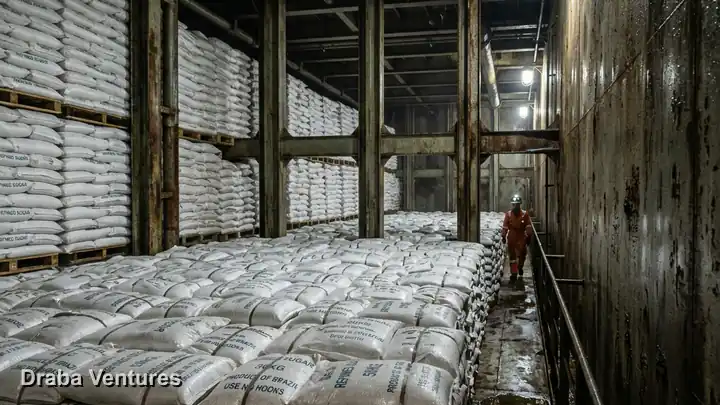
Executive Summary for Exporters & Procurement Teams: To prevent container sweat and cake formation in bulk PP-bagged sugar, load cargo at a maximum moisture content of 0.04% to 0.06%, line container floors and walls with heavy-duty Kraft paper, and install at least 1.2 to 1.5 kg of high-absorption calcium chloride desiccant per MT of cargo. Sealing containers in dry interior microclimates stabilizes Equilibrium Relative Humidity (ERH) strictly below 60%.
Calculate Sugar & Agri-Commodity Export Freight
Estimate landed CIF and FOB container costs for refined sugar (S30/M30) and premium Karnataka rice varieties from Sindhanur mills to global ports.
Thermodynamic Physics: The Mechanics of Dew Point
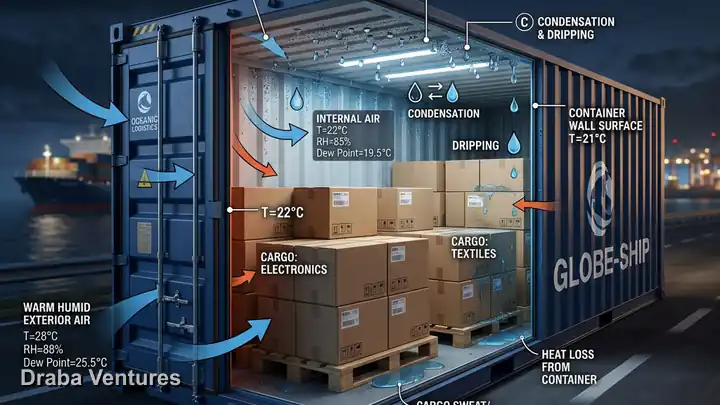
Container sweat—often termed cargo sweat or transit condensation—is fundamentally governed by the laws of thermodynamic physics. As a shipping container travels from a hot, humid origin port to cooler temperate zones, the steep thermal gradient across the steel container walls creates an active micro-weather system inside the unit.
The air space inside a sealed 20ft or 40ft dry-van container holds a specific absolute humidity. When external ambient temperature drops, uninsulated steel panels cool rapidly. Once internal surface temperature falls below the trapped air's dew point, gaseous water vapor liquefies into droplets on the ceiling, raining down onto uppermost layers of PP-bagged sugar.
Critical Dew Point Note: Air at 30°C (86°F) with 70% relative humidity holds approximately 21 grams of water per cubic meter. If container skin temperature drops to 24°C (75°F), that same volume can hold only 21 grams; any further drop triggers immediate condensation. The surplus moisture is expelled as container sweat.
Vapor Pressure Deficit and the Container Microclimate
The risk of condensation is amplified by Vapor Pressure Deficit (VPD). When shipping bulk agricultural cargo, the commodity respires and interacts with the internal atmosphere. Although refined white sugar (sucrose) has a very low intrinsic moisture content (<0.06%), it is highly hygroscopic, actively seeking moisture equilibrium with surrounding air.
The microclimate inside a container is a closed thermodynamic system. Daytime solar radiation can spike internal temperatures beyond 50°C, expanding air and lowering relative humidity, which causes latent moisture in PP bags, pallets, or Kraft linings to evaporate. During nightfall, rapid cooling reverses this process, pumping moisture out of packaging by day and condensing it on the roof by night.
The Caking Chemistry of Sucrose in Bulk Bags
Sucrose caking is a physical-chemical phenomenon where individual sugar crystals bind together into an unyielding solid block. This renders sugar unusable for bulk handling and industrial processing without costly milling.
Caking is triggered when Equilibrium Relative Humidity (ERH) exceeds 60%. When condensation drips onto woven Polypropylene (PP) bags, moisture penetrates fabric micro-pores and inner polyethylene liners, dissolving the surface of sugar crystals to create a supersaturated sucrose syrup.
When temperature rises or humidity drops, this thin film of syrup recrystallizes into solid bridges (inter-particle bonds) between adjacent crystals. Because these bridges possess the exact crystalline structure of primary particles, bond strength is immense, causing severe cake formation.
Temperature Gradients & Moisture Migration
Sugar does not only cake when liquid water drips onto it. Sheer temperature migration within the cargo block triggers cake formation through moisture migration.
If outer edges of stacked cargo are exposed to cold container walls, relative humidity in those cold zones spikes. Moisture moves from the warmer center of the stow toward cooler peripheries to balance vapor pressure. Crystals at cold edges absorb migrating moisture, dissolve slightly, and fuse as temperatures equalize, creating massive crusts of caked sugar along container walls even without ceiling drips.
Desiccant Math Blueprint: Calculating Moisture Load
Relying on standard 1-kg silica gel packets is completely ineffective for dense bulk commodities. A precise desiccant calculation blueprint is required to account for air volume, transit duration, and packaging moisture release.
A standard 20ft container holds approximately 33 cubic meters of air space. At tropical loading conditions (35°C / 80% RH), free air holds roughly 1 liter of suspended water. However, wooden pallets can hold up to 15 liters of moisture, and Kraft linings another 5 liters. Over a 30-day ocean transit, total evaporative load can exceed 30 liters of water.
For bulk PP-bagged sugar, industry standards mandate 1.2 kg to 1.5 kg of high-absorption Calcium Chloride (CaCl2) desiccant per Metric Ton (MT) of cargo. Calcium chloride absorbs up to 280% of its own weight in moisture, whereas silica gel peaks at ~30%. For a 24 MT payload, a minimum of 28 to 36 kg of CaCl2 desiccant poles must be installed on lashing rings.
Bulk Logistics Data & Technical Specifications
The following table outlines thermodynamic thresholds and quality parameters critical for preventing cake formation in bulk shipments:
| Technical Parameter | Safe Threshold | Critical Risk Level |
|---|---|---|
| Sucrose Moisture Content | ≤ 0.04% - 0.06% | > 0.10% (High caking risk) |
| Equilibrium Relative Humidity (ERH) | < 60% | > 65% (Crystal bridge formation) |
| Desiccant Requirement (CaCl2) | 1.2 kg - 1.5 kg / MT | < 0.5 kg / MT (Sweat imminent) |
| Container Floor Moisture | < 15% | > 18% (Evaporative load too high) |
Real-World Wholesale Price Dynamics (Karnataka Hub)
For B2B buyers—wholesalers, distributors, modern retail, and HORECA—understanding current bulk commodity pricing across the Karnataka belt (Sindhanur, Raichur, Gangavati) is vital for procurement planning:
| Commodity / Grade | Price per Quintal (₹) | Price per 26kg Bag (₹) | Price per Metric Ton (₹) |
|---|---|---|---|
| Sugar - S30 Grade (Standard) | ₹3,750 | ₹975 | ₹37,500 |
| Sugar - M30 Grade (Premium) | ₹3,850 | ₹1,001 | ₹38,500 |
| Sona Masoori Rice (Benchmark) | ₹3,400 | ₹884 | ₹34,000 |
| RNR Samba Masuri (Low GI) | ₹3,200 | ₹832 | ₹32,000 |
The Role of Gangavati & Sindhanur Microclimates in Loading
Geographic origin of cargo loading strongly dictates initial container microclimates. Operating in the Tungabhadra irrigation belt, Draba Ventures leverages unique microclimates across Sindhanur, Gangavati, Karatagi, and Raichur.
Unlike humid coastal ports where relative humidity regularly exceeds 85%, loading in Sindhanur or Raichur occurs in ambient humidity levels often below 45%. Sealing containers with this dry air minimizes initial absolute humidity, establishing a safe starting baseline for long maritime voyages.
Frequently Asked Questions
Direct Commodity Sourcing with Zero-Moisture Protocols
Whether you are procuring bulk refined sugar (S30/M30) or sourcing premium Sona Masoori and Basmati rice, Draba Ventures enforces strict moisture-barrier protocols from Tungabhadra mills to global destination ports.
Request Bulk Wholesale Quotation