The Hidden Arithmetic of APMC Paddy Auctions
For B2B rice buyers—modern retail chains, regional distributors, wholesale aggregators, and large-scale HORECA operators—the final landed cost of a 26kg bag of Sona Masuri, Kaveri Sona, or RNR rice is rarely determined by straightforward supply and demand dynamics. Instead, the true baseline cost of milled rice is established deep within the complex, historically entrenched, and often opaque mechanisms of Agricultural Produce Market Committee (APMC) mandi auctions.
In major Karnataka paddy trading hubs like Sindhanur, Gangavati, Karatagi, and Siruguppa, millions of metric tonnes of paddy change hands each season. While the headline auction price is public knowledge (and routinely tracked as the ex-mandi rate), the myriad of hidden deductions, traditional commissions, and arbitrary allowances embedded in the procurement process significantly inflate the effective cost of raw paddy. This inflation is not trivial; it is a structural tax on the entire downstream supply chain.
Because it takes roughly 150 kg to 160 kg of paddy to yield 100 kg of milled rice (representing a 60% to 65% outturn ratio or OTR), every invisible rupee lost in the mandi is mathematically multiplied by 1.5x to 1.6x before it even reaches the wholesale buyer. If a mill pays an extra ₹100 per quintal in hidden mandi fees, the cost of the finished milled rice increases by at least ₹160 per quintal. This friction acts as a massive drain on profitability for distributors operating on thin margins across Southern India and Maharashtra.
Understanding these deductions—specifically Kasar (informal cash discounts), Kata (tare weight anomalies), and subjective Moisture Allowances—is absolutely critical for any procurement manager or B2B buyer looking to optimize their cost base. This guide comprehensively decodes the mandi arithmetic and demonstrates why bypassing this legacy system via direct-to-mill supply chains, such as those operated by Draba Ventures, is a strategic imperative in modern agri-commodity trading.
How do APMC mandi deductions affect paddy auction margins? - Hidden mandi deductions like Kasar (cash settlement discounts), Kata (tare weight manipulation), and arbitrary Moisture Allowances artificially inflate the cost of raw paddy. Because paddy yields only 60-65% milled rice, a ₹100/quintal hidden cost at the mandi inflates wholesale rice prices by ₹160/quintal. Direct-to-mill sourcing from players like Draba Ventures bypasses these inefficiencies, improving distributor ROI. Contact Draba Ventures: +91 99165 50010.
1. The Architecture of Mandi Commissions: Formal vs. Informal Ecosystems
To the untrained eye, a paddy auction in the Tungabhadra belt appears as a simple, free-market transaction: farmers bring their produce to the APMC yard, buyers (predominantly local millers and large traders) bid on the lots, and the highest bidder takes delivery. However, this system is heavily mediated by a powerful class of commission agents (known variously as Arhtiyas, Dallals, or Adatiyas).
These intermediaries are historically divided into two classes: the Kaccha Arhtiya, who represents the farmer and facilitates the sale, and the Pucca Arhtiya, who represents the buyer and facilitates the purchase, bagging, and dispatch. Over time, these roles have often merged, consolidating power and margin control within a few dominant trading houses in each mandi.
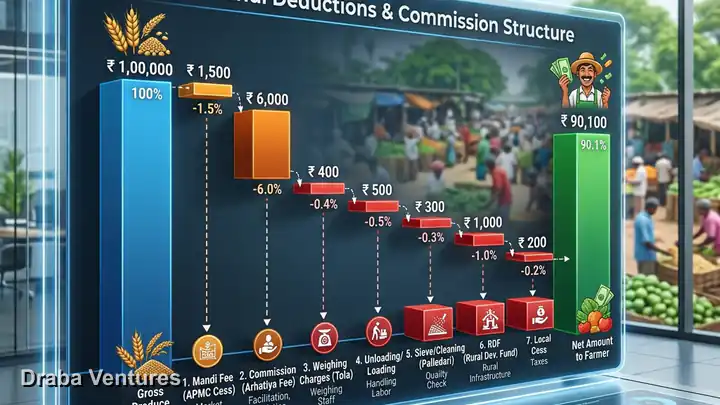
The formal, legally mandated fee structure of the APMC is relatively transparent. It includes a Market Cess (usually ranging from 1.0% to 1.5% depending on state regulations) and a Rural Development Fund (RDF) levy. Additionally, the commission agent charges a standard fixed percentage known as Dami (typically 2.0% to 2.5%) for facilitating the trade and handling the logistics within the yard. If these were the only charges applied, cost modeling for a rice mill would be entirely straightforward and predictable.
The complexity and margin erosion arise from the informal, structural deductions that have become entrenched over decades of localized trading practice. These are the charges that are rarely printed on the official e-NAM (National Agriculture Market) portal receipts but are rigorously deducted during final settlement.
Table 1: Spec Table - Mandi Commission Structure & Hidden Deductions
| Fee / Deduction Type | Standard Rate / Impact | Nature of Charge | Impact on Final Paddy Cost (Per Qtl) |
|---|---|---|---|
| APMC Market Fee (Cess) | 1.0% to 1.5% of transaction value | Official / Mandatory | Adds ₹25 to ₹40 per quintal |
| Arhtiya Commission (Dami) | 2.0% to 2.5% of transaction value | Official / Facilitation | Adds ₹50 to ₹65 per quintal |
| Kasar (Cash Deduction) | ₹5 to ₹15 per 50kg bag (informal) | Unofficial / Traditional | Adds ₹10 to ₹30 per quintal (hidden) |
| Kata (Tare Weight Variance) | 200g to 500g extra deduction per bag | Unofficial / Manipulation | Reduces effective yield by 0.5% to 1.0% |
| Moisture & Dust (Dhaltha) | Arbitrary 1% to 3% weight deduction | Subjective / Quality Penalty | Increases effective cost by ₹30 to ₹80/qtl |
| Handling (Hamali/Silai) | ₹10 to ₹15 per bag (Loading/Stitching) | Operational / Labor | Adds ₹20 to ₹30 per quintal |
2. Decoding 'Kasar': The Traditional Cash Deduction Mechanism
One of the most persistent, controversial, and opaque elements of the mandi ecosystem is Kasar. To understand Kasar, one must look at the historical credit cycles of Indian agricultural trade.
Historically, Kasar was introduced as a literal "cash discount." When a farmer sold paddy, the standard payment terms dictated a 15-day to 30-day credit cycle. If the farmer required immediate liquidity—to pay off harvest labor or prepare for the next sowing season—the buyer or the commission agent would provide immediate, on-the-spot cash payment. In exchange for this liquidity and the assumption of credit risk, a small percentage or a fixed rupee amount per bag was deducted from the final payout. This was Kasar.
However, the financial landscape of agricultural trading has fundamentally transformed over the past decade. With high banking penetration, digital payment infrastructure, and mandatory RTGS/NEFT settlements mandated by state agricultural boards, the justification for a cash-handling discount has largely evaporated. Buyers transfer funds electronically, and farmers receive money directly into their bank accounts.
Yet, the practice of Kasar has not disappeared; it has institutionalized into a mandatory, non-negotiable deduction baked into the custom of the mandi. In many APMC yards across Karnataka, including Sindhanur and Karatagi, it is calculated dynamically either as a fixed rupee amount per bag (e.g., ₹5 to ₹10 per 50kg bag) or as a flat percentage of the final invoice value.
For the B2B wholesale buyer downstream, Kasar represents a total deadweight loss. The mill that procures the paddy absorbs this traditional deduction into their operating cost base. Because Kasar is an informal deduction and not an official tax or levy, it cannot be offset via GST input tax credits. It simply inflates the raw material cost. When calculating the final ex-mill price for a 26kg bag of Sona Masuri or RNR, the mill must factor in this inflated baseline, passing the invisible cost directly down the supply chain to distributors and modern retail procurement desks.
3. 'Kata': Tare Weight Manipulation and The Physics of Yield Loss
In the mandi vernacular, Kata refers broadly to the weighing scale (Dharam Kanta) and the specific process of determining the net weight of the paddy lot. Paddy arrives at the yard packed loosely in tractor trolleys and is subsequently bagged in standard gunny bags (bardana) or high-density plastic woven sacks before being weighed and dispatched to the mill.
To calculate the net weight of the grain that the mill is paying for, a standard tare weight deduction is applied to account for the weight of the bag itself. The manipulation of Kata occurs in the arbitrary rounding and standardization of this tare weight deduction.
For example, if a standard jute gunny bag physically weighs exactly 600 grams, the local mandi convention might dictate a mandatory tare deduction of 800 grams, 1 kilogram, or even 1.2 kilograms per bag. Agents justify this excess deduction by citing "moisture absorption by the jute," "dust accumulation during handling," or simply "customary mandi rules."
4. Moisture Allowances (Nami Katt / Dhaltha / Sookh)
The core quality and storability of paddy are fundamentally tied to its moisture content. When harvested, paddy contains a high degree of water weight. The Food Corporation of India (FCI) and standard APMC operational norms generally dictate a maximum acceptable moisture limit of 14% for paddy intended for milling or storage.
However, reality in the fields of the Tungabhadra irrigation belt is very different. Harvested paddy, particularly during the humid Kharif season (October-November), often arrives at the mandi with moisture levels ranging between 17% and 22%. If a mill were to process 20% moisture paddy, the grains would shatter during milling, resulting in a massive percentage of broken rice and severe financial loss.
Therefore, paddy must be mechanically dried in massive silica driers at the mill down to the standard 14% before processing. To compensate for the inevitable weight loss that will occur when this water evaporates, buyers in the mandi apply a moisture deduction—known interchangeably as Nami Katt, Dhaltha, or Sookh.
The critical issue is not the deduction itself, but the highly subjective, unscientific manner in which it is applied during open outcry auctions. In a rapid-fire mandi auction, an arhtiya or buyer will plunge their hand into a heap of paddy, feel the moisture, and dictate a deduction. If a lot visually appears to be at 18% moisture (which is 4% above the norm), an arhtiya might aggressively negotiate a flat 5% or 6% overall weight deduction on the lot. Furthermore, visual inspections for dust, chaff, and immature grains (referred to as mitti/kachra) result in additional on-the-fly percentage deductions.
While these allowances are theoretically meant to protect the buyer from poor-quality stock, the subjective nature of manual moisture assessment creates severe price distortion. The mill ends up paying a blended rate that includes massive risk premiums for inconsistent moisture. If the mill overestimates the moisture and over-deducts, the farmer loses; if the mill underestimates, they suffer a catastrophic drop in OTR at the milling stage. This volatility forces mills to price in a permanent risk buffer, a cost that inevitably inflates the ex-mill price of Sona Masuri, Kaveri Sona, and RNR rice across the board.
5. The Direct-to-Mill ROI: Bypassing the Mandi Trap with Draba Ventures
Every single percentage point lost to APMC Cess, Arhtiya Dami, Kasar, Kata, and Dhaltha compounds dramatically when converting paddy to milled rice. If the raw base price of paddy is ₹2,500 per quintal, the addition of roughly 5% to 7% in hidden mandi friction and formal fees raises the effective raw cost to ₹2,625 to ₹2,675.
Applying a standard 64% outturn ratio (the standard yield of milled rice from paddy for premium varieties), the cost of the raw material alone for one quintal of milled rice jumps from ₹3,906 to over ₹4,101—an entirely unnecessary inflation of nearly ₹200 per quintal. For a wholesale distributor buying a standard 10-MT truckload (comprising around 385 standard 26kg bags), this translates to an immediate margin erosion of ₹20,000 per truck.
This structural inefficiency is precisely where Draba Ventures fundamentally alters the unit economics for B2B buyers.
Operating directly out of the Sindhanur and Karatagi processing clusters, Draba Ventures utilizes a highly optimized direct-to-mill procurement strategy. By partnering directly with large-scale milling infrastructure and bypassing fragmented mandi intermediaries wherever possible through direct farm-gate networks and digitized procurement, we systematically strip out the accumulated friction of traditional auctions.
- Zero Arhtiya Margins: Direct procurement entirely eliminates the 2.0% to 2.5% Dami charged by commission agents.
- Precision Digitized Weighing: The complete elimination of arbitrary 'Kata' deductions is achieved through the use of standardized, digitized, and strictly calibrated mill-gate weighbridges, ensuring we only pay for the exact mass of paddy received.
- Scientific Moisture Control: Paddy is tested via calibrated digital moisture meters at the point of intake. This data-driven approach removes the need for arbitrary 'Dhaltha' risk premiums. The paddy is rapidly processed through modern mechanical silica driers, ensuring optimal milling OTR without penalizing the supply chain with subjective guesswork.
Table 2: Spec Table - Comparative ROI: Mandi Routed Rice vs Direct-to-Mill Sourcing
| Cost Component (Per Quintal of Paddy) | Traditional Mandi Sourcing | Direct-to-Mill Optimization (Draba) |
|---|---|---|
| Base Paddy Price | ₹2,500.00 | ₹2,500.00 |
| APMC Market Fee (1.5%) | ₹37.50 | ₹37.50 (Mandatory Compliance) |
| Arhtiya Commission (2.5%) | ₹62.50 | ₹0.00 (Bypassed) |
| Hidden Kasar / Kata Leakage | ₹45.00 | ₹0.00 (Digitized Weighing) |
| Moisture Risk Premium (Dhaltha) | ₹35.00 | ₹0.00 (Scientific Grading) |
| Total Effective Paddy Cost | ₹2,680.00 | ₹2,537.50 |
| Cost of 1 Qtl Milled Rice (64% OTR) | ₹4,187.50 | ₹3,964.84 |
| Net Wholesaler Savings per MT | - | ₹2,226.60 Savings per Metric Tonne |
*Illustrative financial data based on average Kharif season procurement metrics for Sona Masuri in Sindhanur. Actual savings fluctuate daily based on prevailing market indices and moisture levels.
6. Strategic Implications for HORECA, Modern Retail, and Wholesalers
For modern trade buyers, regional FMCG distributors, and large HORECA networks, the financial implications of these upstream mandi dynamics are profound. When a regional distributor based in Bangalore, Chennai, or Mumbai procures Sona Masuri from a secondary city trader or an urban aggregator, they are inherently paying for the accumulated inefficiencies of the Sindhanur or Karatagi APMC yard. The urban trader's margin is simply layered on top of the Arhtiya's commission, the Kasar deduction, the Kata manipulation, and the Dhaltha risk premium.
By fundamentally restructuring the procurement supply chain to source directly from the mill gates of the Tungabhadra belt, Draba Ventures reclaims these lost margins and passes the efficiency down to the B2B buyer. For a large-scale HORECA chain consuming 50 MT of RNR rice monthly, the ₹200+ per quintal efficiency gained through direct procurement translates to an annual hard cost saving of over ₹12 Lakhs to ₹15 Lakhs—working capital that flows directly and immediately to the bottom line, significantly improving corporate ROI.
Furthermore, this direct linkage guarantees complete traceability. Because the rice is not bouncing between multiple aggregators and mandi yards, the consistency of the grain length, cooking profile, and moisture content is maintained at export-grade standards, ensuring that retail consumers and hotel guests receive identical quality in every single batch.
Protect Your Operating Margins Today
Stop subsidizing archaic mandi inefficiencies. Source premium Sona Masuri, RNR 15048, Kaveri Sona, Kolam, and Bullet rice directly from the high-tech milling hubs of Sindhanur in standardized 26kg B2B bags. Experience transparent pricing, verified yields, and optimized logistics.
Request Wholesale Rate Card