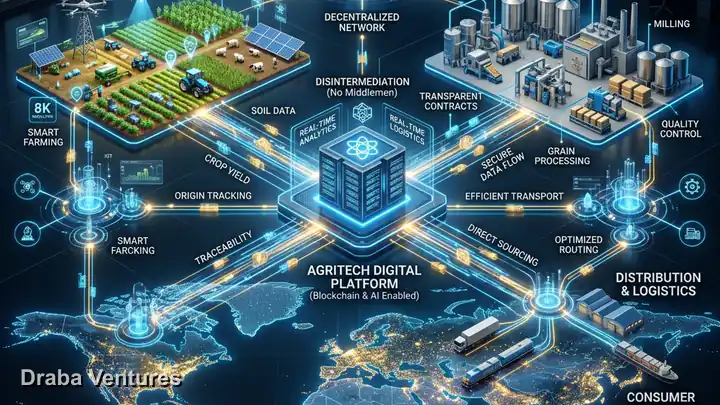
Agritech platforms are disintermediating the traditional rice mandi supply chain in three critical ways: 1) Digitizing quality assaying using computer vision and IoT to eliminate subjective visual inspections by brokers; 2) Implementing price discovery algorithms that match real-time mill inventory with buyer demand, bypassing APMC auction cartels; and 3) Shifting disintermediation margins, essentially reallocating the historical 2-5% dalali (commission) and handling losses back to millers and bulk B2B buyers (HORECA, modern retail). This ensures objective procurement, cost savings, and verifiable traceability across India's premier rice hubs like the Gangavati-Karatagi belt.
The traditional rice supply chain in India has operated on a deeply entrenched system of localized trust, manual negotiations, and fragmented intermediary networks for decades. For a wholesale buyer sitting in Bengaluru, Chennai, or Mumbai looking to procure bulk quantities of Sona Masuri or RNR rice from the fertile plains of Karnataka, navigating the opaque pricing structures of a traditional Agricultural Produce Market Committee (APMC) mandi is notoriously complex. However, the last five years have ushered in a tectonic shift. The emergence of robust agritech platforms is fundamentally rewriting the operational blueprint of how agricultural commodities move from the mill-gate to the modern distributor's warehouse.
This technical dive explores how data-driven B2B agri-marketplaces, integrated with physical supply chain capabilities, are resolving the structural inefficiencies of traditional trading. By anchoring our analysis in the Tungabhadra irrigation belt—encompassing Gangavati, Karatagi, Sindhanur, Raichur, and Siruguppa—we dissect the exact mechanisms of quality assaying digitization, price discovery algorithms, and the ultimate shifts in disintermediation margins that forward-thinking buyers must leverage in 2026.
The Anatomy of the Traditional Rice Mandi in Karnataka
To understand the disruption, one must first deconstruct the existing architecture. The standard rice mandi ecosystem in the Gangavati–Karatagi belt relies heavily on a multi-tiered layer of intermediaries. These include the kacha arhtiya (primary commission agent representing the farmer), the pacca arhtiya (secondary commission agent operating on behalf of out-of-state wholesale buyers), and various dalals (brokers) who facilitate the actual match-making between the rice millers and the end buyers.
In this legacy framework, price setting is opaque and deeply subjective. A traditional broker walks into a mill, visually inspects a handful of rice, performs a "bite test" to estimate moisture, and negotiates a rate based on an intuitive feeling of market scarcity rather than data. The margin stack in this model typically adds 2% to 5% to the final landing cost for the B2B buyer. Furthermore, the risk of adulteration, subjective grading (where "Premium Sortex" is a highly elastic term), and unpredictable fulfillment timelines are treated as systemic costs of doing business.
This system, while resilient, fails the modern demands of HORECA chains, modern kirana aggregators, and massive distributors who require precision, standardized packaging (specifically the staple 26kg PP woven bag), and data-backed quality assurance.
Quality Assaying Digitization: From Subjective Bite to Objective Byte
The most immediate intervention by agritech platforms has been the complete digitization of quality assaying. Quality is no longer a matter of a broker's opinion; it is a rigid, certifiable metric.
Modern agritech supply chains deploy IoT-enabled moisture meters and AI-driven computer vision systems directly at the mill level. Before a batch of Sona Masuri or Kaveri Sona is cleared for a B2B transaction, a representative sample is passed through a localized digital assaying unit. Computer vision algorithms analyze the grain structure, instantaneously calculating the exact percentage of broken grains, chalky grains, and foreign matter. The moisture content is objectively recorded to the decimal (e.g., 13.2%).
For procurement heads at modern retail chains, this digitized assaying translates directly to standard operating procedure (SOP) compliance. If an order specifies RNR (Samba Masuri) with a low Glycemic Index profile, maximum 14% moisture, and a specific length-to-breadth ratio, the agritech platform programmatically matches this requirement with a pre-assayed mill lot in Siruguppa or Sindhanur. The result is zero ambiguity.
Price Discovery Algorithms: Breaking the Auction Cartel
The second pillar of disintermediation is algorithmic price discovery. In traditional mandis, prices are heavily influenced by the immediate physical presence of buyers and the localized gossip of supply shortages. It is not uncommon for a cartel of commission agents to artificially inflate wholesale prices in anticipation of a slight delay in the Kharif harvest arrivals.
Agritech platforms neutralize this through big data. By aggregating real-time inventory data across hundreds of partnered mills in the Gangavati-Karatagi cluster and combining it with macro data inputs—such as historical seasonal pricing curves, government Minimum Support Price (MSP) declarations, weather disruptions, and real-time logistics costs—these platforms generate dynamic, fair-market price discovery models.
When a B2B buyer queries the system for 10 Metric Tonnes (approx. one truck load) of Sortex Clean Sona Masuri, the algorithm instantly computes the optimal ex-mill rate. It factors in the precise quality grade and calculates the real-time freight cost from Raichur to the buyer's warehouse. This radical transparency replaces the murky margin-stacking of the past.
Current Wholesale Rice Price Points in Karnataka (May-July 2026)
To contextualize the impact of digital procurement, below is the real-time, data-backed pricing generated through direct mill linkages in the Tungabhadra belt. These are algorithmically derived ex-mill prices, stripped of the traditional 2-3% dalali padding. Note that standard B2B domestic transactions happen in standard 26kg PP woven bags.
| Rice Variety | Grade Profile | Price Per Quintal (100 kg) | Price Per 26kg Bag | Price Per MT (1,000 kg) |
|---|---|---|---|---|
| Sona Masuri (HMT) | Premium Sortex, <14% Moisture | ₹3,200 - ₹3,600 | ₹832 - ₹936 | ₹32,000 - ₹36,000 |
| Kaveri Sona | Standard Sortex, Karnataka Hybrid | ₹3,400 - ₹3,800 | ₹884 - ₹988 | ₹34,000 - ₹38,000 |
| RNR (Samba Masuri / 15048) | Low GI, HORECA Grade | ₹3,000 - ₹3,400 | ₹780 - ₹884 | ₹30,000 - ₹34,000 |
| Bullet Rice | Medium-Bold, Starchy | ₹2,800 - ₹3,200 | ₹728 - ₹832 | ₹28,000 - ₹32,000 |
| Kolam Rice | Long-Slender (5.8-6.5mm) | ₹3,100 - ₹3,500 | ₹806 - ₹910 | ₹31,000 - ₹35,000 |
Note on MOQ and Logistics
The standard Minimum Order Quantity (MOQ) for direct mill procurement remains 1 truck load (approximately 10-12 MT). While agritech platforms provide the price discovery, execution relies on robust physical infrastructure. Draba Ventures facilitates this end-to-end fulfillment, providing seamless logistics from the Sindhanur and Gangavati mills directly to your domestic distribution centers.
Disintermediation Margin Shifts: Follow the Money
When you strip away the layers of a traditional supply chain, where does the saved margin go? In a conventional transaction, if a quintal of Sona Masuri is sold by the mill at ₹3,200, the kacha arhtiya might take ₹30-₹50, the pacca arhtiya takes ₹60-₹80, and the localized broker takes another ₹30. Add in the inherent "shrinkage" or handling loss due to multiple loading and unloading points, and the buyer ends up paying effectively ₹3,400 per quintal before transport.
Agritech platforms force a margin shift. By connecting the B2B buyer directly to the miller via a digital ledger, that ₹200 spread is reallocated. The platform typically charges a transparent fulfillment fee (often less than 1%), allowing the miller to realize slightly better realization (say, ₹3,250), while the buyer procures at ₹3,282 instead of ₹3,400.
This 3-5% optimization in procurement cost is revolutionary for low-margin, high-volume businesses like kirana aggregators and large-scale caterers. When annualized over thousands of metric tonnes, algorithmic disintermediation directly pads the EBITDA of the procuring company.
B2B Technical Specifications: Digital Procurement Benchmarks
A critical advantage of digital sourcing is adherence to strict specifications. The table below highlights the standardized parameters for the top Karnataka varieties sourced via our network. These parameters are non-negotiable thresholds maintained by digital assaying.
| Variety | Grain Length (mm) | Broken Tolerance | Key Attribute / Use Case | Target Market |
|---|---|---|---|---|
| Sona Masuri (HMT) | 5.2 - 5.7 | <5% (Premium <3%) | Lightweight, everyday staple. Excellent milling recovery. | Karnataka, AP, Maharashtra Retail |
| Kaveri Sona | 5.5 - 6.0 | <4% | Slightly longer than HMT, lower broken percentage natively. | Tamil Nadu, AP Premium Markets |
| RNR (BPT 5204) | 5.0 - 5.5 | <5% | Low Glycemic Index (~51-52), excellent for health segments. | HORECA, Institutional Catering |
| Bullet Rice | Medium-Bold | <8% | Highly starchy, high volume expansion post-cooking. | Value-tier Kirana, Specific Canteens |
| Kolam Rice | 5.8 - 6.5 | <5% | Long-slender profile, soft texture, does not stick. | Gujarat, Rajasthan, Maharashtra |
Challenges in Agritech Adoption
Despite the overwhelming efficiencies, the transition is not without friction. The primary challenge remains the trust deficit and credit liquidity. Traditional commission agents did more than just broker trades; they acted as informal financial institutions, extending working capital credit to buyers (often 15 to 30 days) and immediate cash settlements to millers.
Many early software-only agritech platforms failed because they assumed the market only needed price discovery, ignoring the liquidity gap. Today, successful B2B operators like Draba Ventures bridge this by acting as full-stack supply chain partners. We don't just provide a digital quotation; we ensure physical fulfillment, assume the quality risk, and facilitate secure B2B payment terms tailored to verified enterprise buyers.
Why B2B Buyers Must Pivot in 2026
The era of relationship-only, broker-dependent bulk sourcing is sunsetting. For a modern distributor, holding inventory is expensive, and unpredictable quality leads to devastating retail rejections. Digitized procurement out of Karnataka’s premium hubs offers three irreplaceable advantages:
- Perfect Traceability: You know exactly which cluster in Gangavati or Karatagi your 26kg bags originated from.
- Defensible Margins: Disintermediation means you aren't paying for a long chain of unnecessary middlemen.
- Scalable Consistency: You can scale your procurement from 1 truck to 20 trucks a month knowing the digital assaying parameters remain identical.
Draba Ventures Private Limited sits at the intersection of traditional milling relationships and modern supply chain execution in Sindhanur. We bring the transparency of agritech combined with the physical reliability of a deeply rooted local supplier.
Ready to Digitize Your Rice Procurement?
Bypass the traditional mandi brokers. Source premium, sortex-clean Sona Masuri, RNR, and Kaveri Sona directly from the Gangavati-Karatagi mills with absolute quality assurance.
Get Direct Mill-Gate Rates TodayFrequently Asked Questions (FAQs)
1. How does quality assaying digitization impact the traditional rice mandi supply chain?
Quality assaying digitization replaces manual 'bite tests' and visual inspections by dalals with AI-driven computer vision and moisture meters. This eliminates subjective grading and ensures that metrics like broken percentage, moisture content, and chalky grains are measured objectively, allowing B2B buyers to procure precise specifications.
2. What role do price discovery algorithms play in agritech platforms for rice sourcing?
Price discovery algorithms use real-time macro data (weather, government MSPS, macro supply) and micro data (specific lot quality, moisture, local mill stock levels) to determine an objective, fair market value. This disintermediates traditional auction cartels in APMC mandis, ensuring transparent pricing for both millers and distributors.
3. How do agritech platforms shift disintermediation margins in bulk rice trade?
By bypassing kacha arhtiyas, pacca arhtiyas, and local dalals, agritech platforms capture the 2-5% commission previously lost to middlemen. This margin shift allows platforms to offer slightly better prices to millers and lower landing costs for B2B wholesale buyers like HORECA and modern retail.
4. Where are the primary hubs for digital rice sourcing in Karnataka?
The Tungabhadra irrigation belt—encompassing Gangavati, Karatagi, Sindhanur, Raichur, and Siruguppa—is the primary hub for digital B2B rice sourcing in Karnataka, particularly for premium non-basmati varieties like Sona Masuri, Kaveri Sona, and RNR.